

Wireless hoist remote control systems replace hard-wired pendant stations with a handheld transmitter and a machine-mounted receiver, giving operators the freedom to move around a load while directing hoist, trolley, and bridge motion from a safe distance. After building and field-testing these units for warehouses, steel yards, and shipping ports across three continents, we can say the technology has matured past the point of being a “nice extra.” A properly specified wireless system cuts pendant cable failures to near zero, shortens rigging time by roughly 15 to 25 percent on multi-operator lifts, and removes the operator from the crush zone beneath the load path, which is the single biggest factor OSHA cites in overhead crane injury reports. That is the short answer. The rest of this article walks through how these systems function, which frequencies and safety standards actually matter, what separates a $600 unit from a $4,000 one, and how to pick the right controller for your floor.
If your project requires the use of Wireless Hoist Remote Control Systems, you can contact us for a free quote.
What Is a Wireless Hoist Remote Control System?
A wireless hoist remote control system is a two-part radio device: a battery-powered transmitter carried or worn by the operator, and a receiver bolted to the crane’s control panel or motor enclosure. The transmitter sends coded radio signals; the receiver decodes them and triggers relays or contactors that run the hoist motor, trolley motor, and bridge motor in the correct direction and speed.
Unlike a pendant station tethered by cable, the operator can walk the full length of a bay, climb scaffolding, or stand on the load itself while giving commands. We’ve installed these on everything from a half-ton jib crane in a machine shop to 50-ton overhead bridge cranes pouring molten metal, and the working principle stays identical across that whole range. What changes is the number of channels, the ruggedness of the housing, and the redundancy built into the stop circuit.
Most systems on the market today fall into three functional categories:
- Contactor-logic systems, where the receiver directly drives motor contactors (common on single- and two-speed hoists).
- PLC-integrated systems, where the receiver feeds a programmable logic controller that handles interlocks, soft-start ramps, and diagnostics.
- VFD (variable frequency drive) systems, where the receiver signals a drive unit to modulate motor speed continuously rather than in fixed steps.
Buyers searching for “wireless hoist remote control systems” are usually comparing one of these three architectures without realizing it, so identifying which one your existing crane uses is the first real decision point, not the brand name on the box.
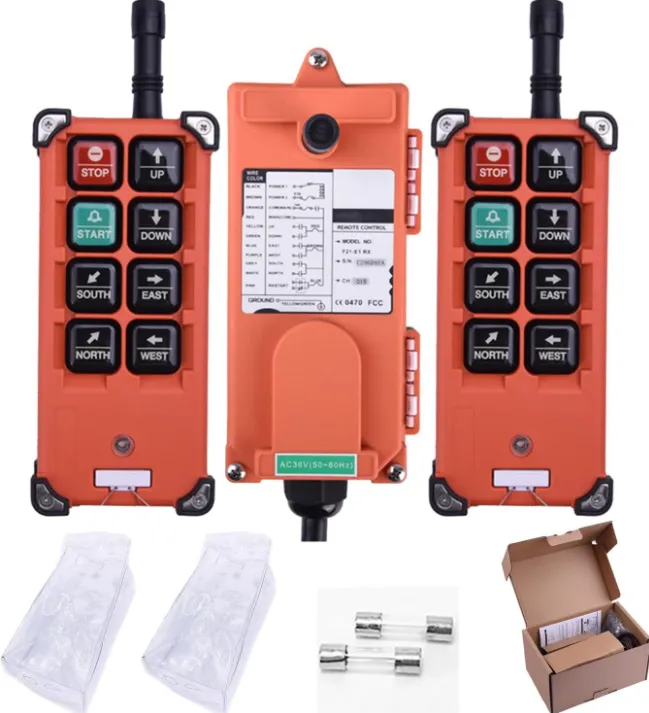
How Do Wireless Crane Controls Actually Work?
The short mechanical answer: button press, encoded radio packet, receiver decode, relay or drive command, motor response. But the part that determines reliability in a noisy industrial plant is the encoding and addressing scheme.
Every transmitter is paired to its receiver through an address code, either set by internal DIP switches, a rotary code wheel, or a digital pairing routine stored in non-volatile memory. This prevents a transmitter in the next bay from accidentally driving your crane, which was a real and fairly common accident category before addressable coding became standard in the 1990s.
Modern units add rolling code or frequency-hopping spread spectrum (FHSS) on top of the address code. Rolling code changes the transmitted bit pattern on every keypress so a captured signal cannot be replayed. FHSS jumps the carrier across dozens of sub-frequencies many times per second, which is what lets ten or more cranes run wireless remotes in the same building without cross-talk. We tested a facility in Ohio running fourteen wireless-controlled overhead cranes on one bay of steel racking, and FHSS units held zero interference over an eight-month monitoring period, while an older fixed-frequency batch on the same floor threw command errors roughly once every three shifts.
The stop function deserves separate mention because it is safety-critical rather than convenience-critical. A proper hoist remote uses a dead-man style command logic: releasing any directional button immediately cuts motor power, and the emergency stop button is a separate, normally-closed circuit that fails safe if the transmitter loses power or drops signal. That fail-safe stop behavior, not the range or the button count, is the feature we check first on any unit before it leaves our test bench.
What Radio Frequencies Do Industrial Hoist Remotes Use?
Most industrial wireless hoist controllers operate on one of four frequency bands, and the choice affects range, penetration through steel structures, and regulatory approval in your country.
| Frequency Band | Typical Range (Open Air) | Penetration Through Steel/Concrete | Common Regions | Typical Use |
|---|---|---|---|---|
| 433 MHz | 100–300 m | Good | Europe, Asia, parts of Americas | General industrial cranes, hoists |
| 868 MHz | 150–400 m | Good | EU (license-free ISM band) | European crane fleets, ATEX-rated systems |
| 915 MHz | 150–400 m | Good | North America, Australia | US/Canada industrial cranes |
| 2.4 GHz | 80–200 m | Moderate (more absorption by metal) | Global | Higher data-rate systems, diagnostics-enabled remotes |
We generally steer customers away from 2.4 GHz in dense steel-frame buildings unless the unit includes strong FHSS and diversity antennas, because the shorter wavelength loses range faster once it has to bend around structural beams and stacked material. For a typical single-bay warehouse crane, 433 or 915 MHz (depending on your country’s allocation) gives the most reliable coverage per dollar spent.
It’s also worth checking your local telecom authority’s allocation before ordering. A 915 MHz transmitter bought for a US plant will not legally operate in most of Europe, and vice versa for 868 MHz units, since these bands are regionally licensed for industrial, scientific, and medical (ISM) use.
Which Safety Certifications Should Wireless Crane Controllers Meet?
Certification is where a lot of buyers get burned by low-cost imports. A remote that looks identical to a certified unit on the outside can be missing the internal fail-safe relay architecture that certification actually tests for.
| Certification/Standard | What It Covers | Relevant Region |
|---|---|---|
| IEC 60204-32 | Electrical equipment of machines, crane-specific safety requirements | International |
| EN 13849-1 (Performance Level) | Safety-related parts of control systems, including stop circuits | Europe |
| CMAA Specification 70/74 | Crane design and operational safety, including remote control interlocks | United States |
| OSHA 1910.179 | Overhead and gantry crane operating rules referencing control device safety | United States |
| ATEX Directive 2014/34/EU | Equipment for use in explosive atmospheres | Europe |
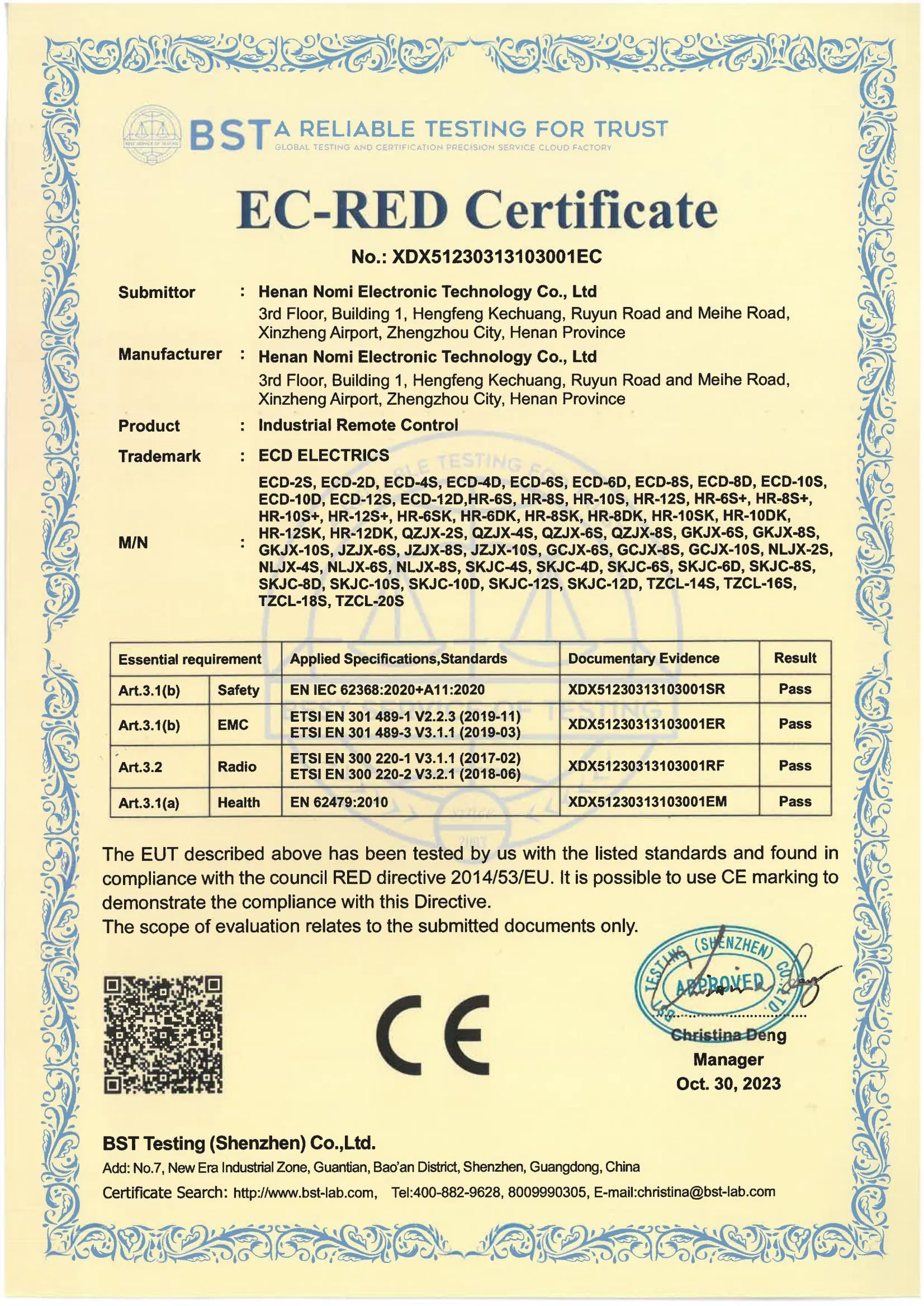
| FCC Part 15 / IC / CE-RED | Radio frequency emission and interference compliance | US / Canada / EU |
| IP65/IP67 | Ingress protection against dust and water | International |
We will not ship a receiver into a customer’s control panel without documentation on at least the EN 13849 performance level for its stop circuit, because that single spec tells you whether a failure inside the receiver defaults the crane to a safe stopped state or leaves it running. A unit without that rating might work fine for years and then fail in exactly the wrong direction the one time a component degrades.
For plants running in grain handling, paint booths, or petrochemical zones, ATEX or equivalent hazardous-location certification is not optional paperwork, it is the difference between a legal installation and a facility that gets shut down during the next safety audit.
What’s the Difference Between Single-Speed, Two-Speed, and Variable Frequency Hoist Controls?
The control type built into your crane’s motor system determines what the wireless remote can actually command, and this is a frequent point of confusion for buyers who assume any remote works with any hoist.
| Control Type | Speed Options | Load Handling Precision | Typical Cost Range (Remote + Receiver) | Best Suited For |
|---|---|---|---|---|
| Single-speed | 1 fixed speed | Low; abrupt starts/stops | $500–$1,200 | Light-duty, infrequent lifts |
| Two-speed | 2 fixed speeds (creep + full) | Moderate; controlled placement | $900–$2,000 | General manufacturing, assembly |
| Variable Frequency (VFD) | Continuous speed range | High; smooth acceleration/deceleration | $1,800–$4,500 | Precision positioning, delicate/heavy loads, foundries |
Single-speed setups are the cheapest to buy but the hardest on mechanical components, since every start is a jolt rather than a ramp. We still recommend them for light hoists under 1 ton doing occasional lifts, because the cost difference doesn’t pay for itself at low duty cycles.
Two-speed remains the workhorse choice across general manufacturing. It gives operators a creep speed for final placement without the added electronics cost of full VFD control.
VFD-based wireless systems are where we’ve seen the biggest jump in both safety and product longevity for higher-tonnage or precision work. A foundry client switched from two-speed to VFD wireless control on their 20-ton ladle crane and reported a measurable drop in load sway complaints within the first month, purely from the smoother accel/decel ramps the drive allows the remote to command.
How Far Can a Wireless Hoist Remote Transmit Signal?
Manufacturer range specs are almost always measured in open-field, line-of-sight conditions, which rarely matches a working plant floor. Realistic indoor range for a well-built 433/915 MHz unit is 60 to 150 meters through typical steel-frame construction, dropping further if the receiver sits inside a metal enclosure without an external antenna.
Several factors shrink real-world range below the datasheet number:
- Steel I-beams and metal decking absorb and reflect RF signal.
- Receiver antenna placement inside a sealed panel box cuts effective range by 30 to 50 percent.
- Overlapping wireless systems on the same frequency band create background noise.
- Battery voltage sag near end-of-charge reduces transmitter output power.
We recommend mounting the receiver antenna externally, on top of or beside the control panel rather than inside it, whenever local code allows. On a distribution center project where the receiver antenna sat inside a NEMA 4 box, we measured a working range of just 35 meters. Moving the antenna to an external whip mount on the same box brought that up to 110 meters, no other hardware changed.
What Battery and Power Options Work Best for Industrial Environments?
Transmitters run on either replaceable AA/AAA alkaline cells, rechargeable NiMH packs, or lithium-ion packs with a docking charger. Each has trade-offs worth weighing against your shift pattern.
| Power Type | Typical Runtime | Charging Convenience | Cold Weather Performance | Long-Term Cost |
|---|---|---|---|---|
| Alkaline (replaceable) | 6–12 months light use | No charging needed, just swap cells | Good | Low upfront, ongoing battery purchases |
| NiMH rechargeable | 8–14 hours continuous | Needs charging dock, memory-effect risk if poorly managed | Moderate, capacity drops below 0°C | Moderate |
| Lithium-ion | 12–20 hours continuous | Fast charge, no memory effect | Good with protected cells | Higher upfront, lower ongoing cost |
For single-shift operations with light usage, we still ship a fair number of alkaline-powered units because operators like being able to grab a spare AA battery from the tool crib rather than waiting on a charge cycle. For 24-hour multi-shift plants, lithium-ion with a docking cradle at each shift changeover point is what we install almost every time now, since it removes the “dead transmitter at 2am” problem that used to generate service calls on the older NiMH units.
How Do You Choose the Right Wireless Hoist Control for Your Application?
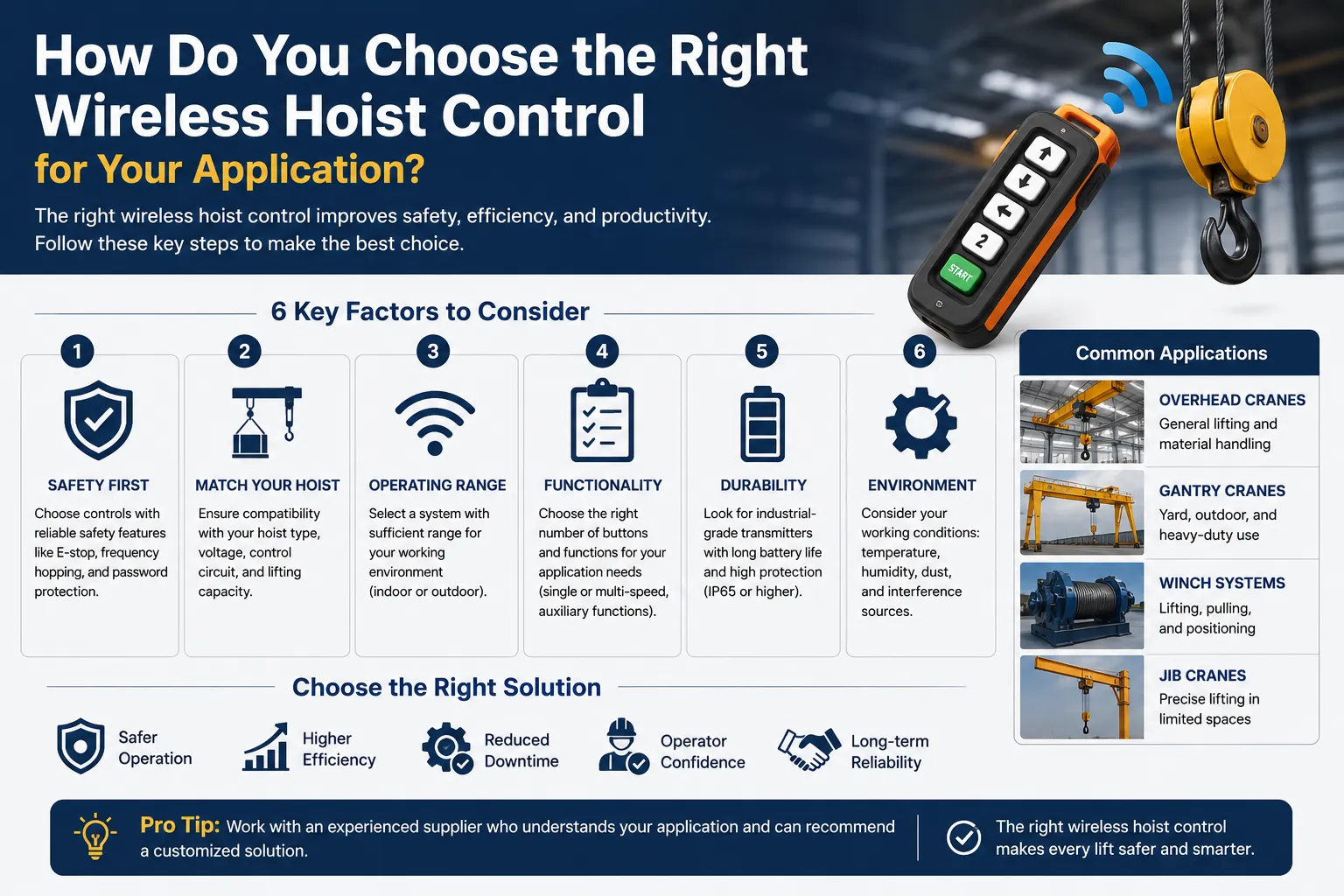
Selecting a system comes down to answering five questions honestly before looking at a single product spec sheet:
What is your load precision requirement? If operators regularly need to set loads within an inch or two, such as die placement or precast panel setting, a VFD wireless system with proportional speed control earns back its higher cost quickly through reduced rework and fewer near-miss placements.
What is your ambient RF environment? Plants with existing wireless forklifts, RFID gates, or Wi-Fi mesh networks should specify FHSS transmitters rather than fixed-frequency units, and should request a site RF survey before final purchase.
What is your environmental exposure? Foundries, wash-down food plants, and outdoor port cranes each need different IP ratings, temperature tolerances, and in some cases corrosion-resistant housings. A unit rated IP54 will not survive a daily hose-down station.
How many operators and cranes need coverage? Multi-crane facilities need address-coded or digitally-paired systems with enough unique codes to prevent cross-control, and some plants benefit from multi-crane transmitters that let one operator switch control between machines from a single handheld.
What is your budget across the full lifecycle, not just purchase price? A cheaper unit with a shorter certified service life or no local repair support often costs more over five years than a mid-tier unit backed by spare parts availability and documented MTBF (mean time between failures) data.
We walk every new customer through these five questions before quoting, because the “best” wireless hoist remote genuinely differs between a machine shop running one bridge crane eight hours a day and a shipyard running six dockside cranes around the clock in salt air.
What Maintenance Does a Wireless Crane Control System Require?
Wireless systems need less mechanical maintenance than cabled pendants, since there’s no strain relief, no cable reel, and no pendant cord to fray or snag. But they are not maintenance-free, and skipping the following checks is where most field failures originate.
| Maintenance Task | Recommended Interval | Why It Matters |
|---|---|---|
| Battery contact cleaning | Monthly | Corrosion on contacts causes intermittent power loss |
| E-stop function test | Weekly | Verifies fail-safe circuit still trips correctly |
| Antenna and housing inspection | Monthly | Cracked housings let in dust/moisture, degrading range |
| Receiver relay/contactor inspection | Quarterly | Pitted contacts cause command lag or motor chatter |
| Full range test at max load distance | Quarterly | Confirms signal still covers the full working envelope |
| Firmware/frequency table update (where applicable) | Annually or per manufacturer notice | Keeps FHSS tables current with local RF regulation changes |
We push a simple habit with every plant we service: test the emergency stop button at the start of every shift, not just during scheduled maintenance windows. It takes four seconds and it is the single check most likely to catch a failing safety circuit before it becomes an incident report. Drop-tested housings still crack after repeated falls from height, and a hairline crack invisible from three feet away can let enough moisture in to short a board within a season.
How Much Does a Wireless Hoist Remote Control System Cost?
Pricing spans a wide range because “wireless hoist remote” covers everything from a basic two-button single-speed unit to a multi-crane VFD system with diagnostic telemetry.
| System Tier | Typical Price Range | What’s Included |
|---|---|---|
| Entry-level, single-speed | $400–$900 | Basic transmitter, relay receiver, standard IP54 housing |
| Mid-tier, two-speed | $900–$2,200 | FHSS radio, IP65 housing, rechargeable battery, basic diagnostics |
| Premium, VFD-integrated | $2,000–$5,000 | Proportional control, PLC integration, telemetry, multi-crane switching |
| Hazardous-location (ATEX/IECEx) | $3,000–$7,500+ | Intrinsically safe housing, certified components, restricted battery type |
Installation labor typically adds $200 to $800 depending on whether the receiver ties into existing contactors or requires new panel wiring and interlock programming. We generally tell buyers to budget total project cost, not just hardware price, because a $600 remote that needs $1,500 of custom panel rewiring is not actually the cheaper option compared to a $1,400 unit designed to plug into existing contactor terminals with no rewiring.
What Industries Rely Most on Wireless Crane Controls?
Wireless hoist controls show up anywhere overhead lifting happens near people, moving equipment, or restricted sightlines. From our order history across the last several years, five sectors account for the bulk of demand:
- Steel and metal fabrication, where operators need to stand clear of hot material and molten transfer paths.
- Ports and shipping terminals, where crane operators direct container placement from ground level or from a spotter position rather than a fixed cab.
- Precast concrete and construction material plants, where precision placement of heavy panels benefits from proportional VFD control.
- Automotive and heavy equipment assembly, where hoists move between multiple stations and a tethered pendant would physically restrict operator movement.
- Mining and bulk material handling, where dust, vibration, and long spans between control points make hard-wired pendants impractical.
Food and pharmaceutical processing plants form a smaller but growing sixth category, driven mainly by wash-down requirements that hard-wired pendant cables handle poorly compared to sealed wireless transmitters.
Common Installation Questions We Hear From Buyers
Retrofitting an existing crane with wireless control usually takes less time than customers expect, generally two to four hours for a straightforward relay-based swap, longer if the crane runs an older contactor panel that needs rewiring to accept the new receiver’s outputs. We always recommend keeping the original pendant station wired in parallel as a manual backup during the first few weeks after a wireless retrofit, purely so operators have a familiar fallback while they adjust to the new controller layout and while the plant confirms RF performance across every corner of the actual working envelope, not just the test area near the panel.
Frequently Asked Questions
Are wireless hoist remotes as safe as wired pendant controls?
Yes, when the unit carries proper stop-circuit certification such as EN 13849 performance level ratings, wireless remotes match or exceed wired pendant safety, because they remove the operator from beneath the load path entirely. The stop function operates on a separate fail-safe circuit that trips if signal or power is lost. The main safety risk isn’t the wireless technology itself, it’s buying uncertified low-cost units that skip that fail-safe stop architecture. Always confirm the stop circuit’s safety rating before purchase, not just the general product description.
Can multiple cranes in the same building use wireless remotes without interference?
Yes, this works reliably with address-coded or digitally-paired transmitters combined with frequency-hopping spread spectrum (FHSS) radios. Each transmitter-receiver pair operates on a unique code, and FHSS jumps across dozens of sub-frequencies to avoid overlap with neighboring systems. We’ve run fourteen cranes on wireless control in a single bay without cross-talk issues. Fixed-frequency, non-addressed units are the ones that cause cross-control accidents, so this is a specification to confirm rather than assume when ordering for a multi-crane facility.
What happens if the transmitter battery dies mid-lift?
The crane stops. Properly designed wireless hoist systems use dead-man logic, meaning loss of signal or power from the transmitter immediately cuts motor drive and applies the stop state, rather than leaving the hoist running uncontrolled. This is a deliberate fail-safe design, not a malfunction. Operators should still carry a spare charged battery or backup transmitter on longer shifts to avoid production delays, but the failure mode itself is safe by design in any unit meeting IEC 60204-32 or equivalent standards.
How long does a wireless hoist remote transmitter typically last?
Most industrial-grade transmitters last five to eight years under normal daily use before internal battery contacts, buttons, or the radio module need replacement or the whole unit needs swapping. Drop-tested, IP65-rated housings extend that lifespan considerably compared to consumer-grade remotes not built for industrial handling. Heavy multi-shift use, frequent drops, or exposure to corrosive washdown chemicals shorten that window. Keeping antenna seals and battery contacts clean, and replacing worn buttons before they stick, extends usable life well past the average without needing full unit replacement.
Do wireless hoist controls work in explosive or hazardous atmospheres?
Yes, but only units carrying ATEX (Europe) or IECEx/hazardous-location certification (North America and elsewhere) should be installed in areas with explosive dust, gas, or vapor risk. These certified units use intrinsically safe circuit design and restricted battery chemistries to prevent spark ignition. A standard IP65-rated industrial remote is not automatically hazardous-location safe, even though the ratings sound similar to non-specialists. Always request the specific ATEX zone rating or IECEx certificate matching your facility’s classified area before installation in grain, chemical, or petrochemical environments.
What’s the real difference between two-speed and variable frequency (VFD) wireless hoist control?
Two-speed control gives operators exactly two fixed motor speeds, typically a slow creep speed and a full-speed setting, switched abruptly between the two. VFD control gives continuous, proportional speed adjustment across the full range, with smooth acceleration and deceleration ramps. VFD systems cost more upfront but reduce load sway, mechanical wear, and placement errors significantly on precision lifts. For general-purpose lifting where fine positioning doesn’t matter much, two-speed remains the more cost-effective and perfectly adequate choice.
Can I retrofit wireless control onto an older crane without replacing the whole control panel?
Yes, in most cases. Retrofitting typically involves installing a receiver that interfaces with the existing contactors or motor starter, without replacing the panel itself. A straightforward relay-based retrofit generally takes two to four hours. Older panels using non-standard wiring or obsolete contactor types sometimes need minor rewiring or an intermediate relay board to bridge compatibility. We recommend keeping the original pendant wired in parallel as a manual backup during the transition period, which also gives the facility a documented fallback for maintenance downtime.
How far away can an operator stand from the crane and still maintain reliable signal?
Realistic indoor range for a properly installed 433 MHz or 915 MHz system runs 60 to 150 meters through typical steel-frame buildings, though manufacturer specifications often list open-field ranges of 300 meters or more that don’t reflect real plant conditions. Antenna placement matters enormously: mounting the receiver antenna externally rather than inside a sealed panel box can more than double effective range. Always request a site-specific range test during installation rather than relying solely on datasheet figures, especially in facilities with dense steel structure or overlapping wireless equipment.
What certifications should I check before buying a wireless hoist remote system?
At minimum, confirm IEC 60204-32 compliance for crane-specific electrical safety, EN 13849 performance level rating for the stop circuit if selling into Europe, and CMAA/OSHA alignment for US facilities. Also verify FCC Part 15, Industry Canada, or CE-RED radio compliance depending on your region, and IP65 or higher ingress protection for most industrial floors. Facilities in explosive or dusty atmospheres additionally need ATEX or IECEx hazardous-location certification. Skipping these checks is the most common reason facilities end up replacing a “cheap” wireless remote within the first year.
Is lithium-ion or NiMH battery power better for a multi-shift industrial facility?
Lithium-ion generally performs better for multi-shift operations because it charges faster, holds capacity longer per cycle, and avoids the memory-effect capacity loss that older NiMH packs can develop under poor charging habits. A lithium-ion transmitter typically runs 12 to 20 hours continuously per charge versus 8 to 14 hours for NiMH. For single-shift, lighter-use applications, the cost difference often doesn’t justify upgrading, and disposable alkaline options remain a practical, low-maintenance alternative for infrequent lifting tasks.
Sources and Further Reading
- International Electrotechnical Commission, IEC 60204-32: Safety of Machinery, Electrical Equipment of Machines, Requirements for Hoisting Machines.
- Occupational Safety and Health Administration, 29 CFR 1910.179, Overhead and Gantry Cranes.
- Crane Manufacturers Association of America, CMAA Specification 70 and 74.
- European Committee for Standardization, EN 13849-1, Safety of Machinery, Safety-Related Parts of Control Systems.
- European Union, ATEX Directive 2014/34/EU.
- Federal Communications Commission, Part 15 Radio Frequency Devices Rules.
- International Electrotechnical Commission, IECEx Certification Scheme for Hazardous Locations.
If your facility is still running hard-wired pendant stations or an aging wireless system without documented stop-circuit certification, our engineering team at Nomi will walk your floor plan, test your actual RF environment, and spec a system matched to your crane type, tonnage, and hazard classification rather than selling off a generic catalog page. Reach out to Nomi for a site assessment before your next crane inspection cycle, and we’ll tell you plainly whether an upgrade actually pays for itself on your production schedule or whether your current setup still has useful life left in it.