

Die beste Funkfernbedienung für einen Kippanhänger ist eine, die genau auf Ihren Hydraulikpumpentyp abgestimmt ist – egal ob einfachwirkend oder doppeltwirkend –, und auf einem 12-V-System basiert, das die tatsächliche Stromaufnahme Ihres Pumpenmotors bewältigen kann, ohne dass es zu Spannungsabfällen kommt, die eine schwache oder verzögerte Zylinderreaktion verursachen. Wir haben drahtlose Fernbedienungssysteme an Kippanhängern installiert, die von kleinen Geräten für den Landschaftsbau bis hin zu Schwerlastanhängern für den Transport von Kies und Bauschutt reichen, und die wiederkehrende Erkenntnis aus jahrelanger Erfahrung ist ganz einfach: Die meisten Beschwerden darüber, dass “die Fernbedienung nicht richtig funktioniert”, lassen sich auf die falsche Kombination einer einfachwirkenden Fernbedienung mit einer doppeltwirkenden Pumpe oder auf einen zu kleinen Querschnitt der Kabel für die Entfernung zwischen Batterie und Pumpe zurückführen.
Was ist eine Funkfernbedienung für einen Kippanhänger und wie funktioniert sie?
Mit einer Funkfernbedienung für einen Kippanhänger kann der Bediener die Kippmulde aus der Ferne anheben und absenken – und zwar mithilfe von Funksignalen anstelle eines am Anhängerrahmen montierten kabelgebundenen Kippschalters oder eines physischen Hebels an der Pumpe. Der Sender, in der Regel ein kleiner Schlüsselanhänger oder ein Handgerät mit Auf-/Ab-Tasten, sendet ein codiertes HF-Signal an einen Empfänger, der an das 12-V-Bordnetz des Anhängers angeschlossen ist. Dieser aktiviert daraufhin ein Relais, das den Motor der Hydraulikpumpe in die richtige Richtung antreibt.
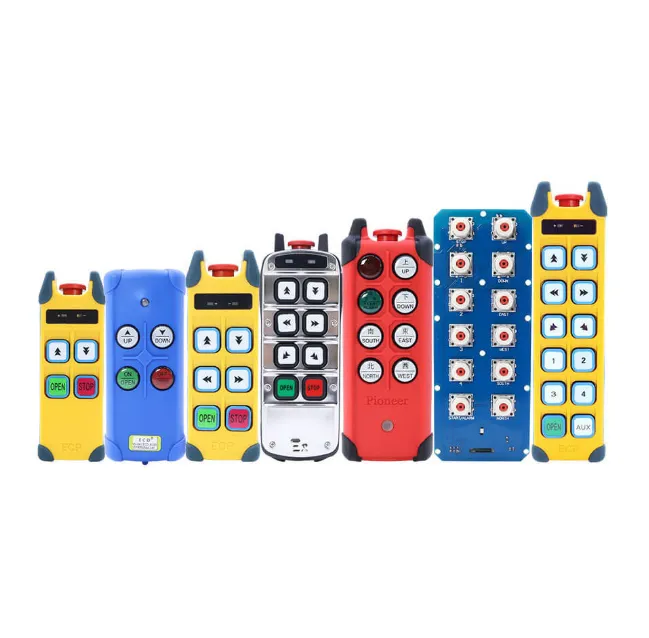
Im Inneren des Empfängergehäuses befindet sich eine kleine Leiterplatte, die das eingehende Signal decodiert, es mit dem Code des gekoppelten Senders abgleicht und entsprechend ein Relais schaltet. Dieses Relais leitet die eigentliche Stromlast zum Pumpenmotor weiter, was bedeutet, dass die drahtlosen Komponenten selbst nur eine sehr geringe Stromstärke führen, während das Relais und seine Verkabelung die Hauptlast übernehmen – je nach Größe des Pumpenmotors oft 80 bis 150 Ampere.
Die meisten derzeit auf dem Markt erhältlichen Funk-Sets für Kippanhänger arbeiten auf der Frequenz 433 MHz, die aufgrund ihres guten Kompromisses zwischen Reichweite und Batterieeffizienz in einem kompakten Sendergehäuse gewählt wurde. Die Reichweite beträgt in freiem Gelände in der Regel 50 bis 150 Fuß, wobei Metallrahmen der Anhänger und in der Nähe befindliche Geräte die effektive Reichweite etwas verringern können.
Warum Wohnwagenbesitzer von der kabelgebundenen zur kabellosen Steuerung wechseln
Bei kabelgebundenen Kippschaltern, die am Anhänger angebracht sind, muss der Bediener direkt am Anhänger stehen, oft in der Nähe des Drehpunkts der Ladefläche – was beim Abkippen von losem oder schwerem Material nicht immer die sicherste Position ist. Mit einer drahtlosen Fernbedienung kann der Bediener einen Schritt zurücktreten, um zu beobachten, wie sich die Ladung verschiebt und die Ladefläche Hindernisse wie überhängende Äste oder Verladeanlagen umfährt – was besonders bei Anhängern wichtig ist, die hohe Ladungen transportieren oder auf engem Raum manövrieren. Das hören wir immer wieder von Bauunternehmern: Der kabelgebundene Schalter war völlig in Ordnung – bis zu dem Tag, an dem sie den Neigungswinkel der Ladefläche aus einer Entfernung von zwanzig Fuß beobachten mussten, während sie rückwärts auf einen Haufen zufuhren; und genau dann hat sich die Umrüstung auf die kabellose Fernbedienung bezahlt gemacht.
Was ist der Unterschied zwischen einfachwirkenden und doppeltwirkenden Hydrauliksystemen bei einem Kippanhänger?
Diese Unterscheidung ist der mit Abstand wichtigste Faktor bei der Auswahl einer kompatiblen Funkfernbedienung, und hier einen Fehler zu machen, ist der häufigste Fehler, den wir bei Erstkäufern beobachten.
| Funktion | Einfachwirkendes System | Doppeltwirkendes System |
|---|---|---|
| Zylinderfunktion | Hydraulikkraft hebt das Bett an; die Schwerkraft senkt es ab | Die hydraulische Kraft hebt und senkt das Bett. |
| Pumpenanforderungen | Einwegpumpe oder Zweileitungspumpe mit Schwerkraftrücklauf | Umkehrbare Pumpe oder Pumpe mit Wegeventil |
| Komplexität der Verkabelung | Einfacher, in der Regel ein Relais für die Aufwärtsfunktion | Erfordert zwei Relais oder ein Umkehrrelais für Auf-/Ab-Betrieb |
| Fernbedienung erforderlich | Einfachwirkende Fernbedienung (bei Betätigung der Auf-Taste läuft der Motor; beim Loslassen senkt sich die Last durch Schwerkraft) | Doppeltwirkende Fernbedienung (getrennte Befehle für Auf- und Ab-Bewegung, beide mit Antrieb) |
| Gängige Anhängertypen | Standard-Kippanhänger, landwirtschaftliche Anhänger | Anhänger, bei denen ein kontrolliertes, motorisiertes Absenken erforderlich ist (empfindliche Ladung, unebenes Gelände) |
| Geschwindigkeitsregelung beim Absenken | Eingeschränkt, schwerkraftabhängig, kann schnell/unkontrolliert sein | Kontrolliertes hydraulisches Absenken mit konstanter Geschwindigkeit |
| Typische Kosten | Nach unten | Höher aufgrund eines zusätzlichen Relais und der Verkabelung |
Einfachwirkende Systeme nutzen die Schwerkraft, um die Ladefläche wieder abzusenken, sobald der Hydraulikdruck nachlässt. Dies funktioniert bei den meisten Standard-Kippanhängern einwandfrei, bedeutet jedoch, dass die Absenkgeschwindigkeit vom Ladegewicht abhängt und sich bei leichteren Ladungen oder unebenem Untergrund abrupt anfühlen kann. Doppeltwirkende Systeme nutzen Hydraulikdruck, um sowohl das Anheben als auch das Absenken zu steuern, was unabhängig vom Ladungsgewicht oder der Neigung des Anhängers für ein sanftes, gleichmäßiges Absenken sorgt; dies erfordert jedoch eine grundlegend andere Pumpen- und Verkabelungskonfiguration.
Wenn Sie eine einfachwirkende Funkfernbedienung für eine doppeltwirkende Pumpe kaufen, können Sie über die Fernbedienung keine Absenkfunktion auslösen, da der Relaisausgang der Fernbedienung nicht so verdrahtet ist, dass er das Umschaltventil oder das zweite Relais steuert, das eine doppeltwirkende Pumpe benötigt. Diese Fehlanpassung ist branchenweit der häufigste Grund für Rücksendungen. Die Überprüfung der Wirkungsart Ihrer vorhandenen Pumpe vor der Bestellung einer Fernbedienung dauert nur zwei Minuten, erspart Ihnen jedoch eine Rücksendung und eine Verzögerung bei der Ausführung Ihres Auftrags.
So finden Sie heraus, welches System derzeit in Ihrem Anhänger verbaut ist
Sehen Sie sich Ihre vorhandene Pumpeneinheit an. Wenn ein einziges Stromkabel zum Pumpenmotor führt und sich das Bett nach dem Loslassen des Schalters von selbst vollständig absenkt, handelt es sich um ein einfachwirkendes System. Wenn Ihr derzeitiger kabelgebundener Schalter über separate Positionen für „Hoch“ und „Runter“ verfügt, bei denen der Schalter jeweils gedrückt gehalten werden muss (das heißt, das Bett bewegt sich ohne Schalterbetätigung in keine der beiden Richtungen), handelt es sich um ein doppeltwirkendes System. Im Zweifelsfall lässt sich jede Unklarheit schnell beseitigen, indem Sie die Teilenummer des Pumpenherstellers mit dessen Datenblatt abgleichen.
Warum ist der Querschnitt der 12-V-Kabel bei Fernbedienungen für Kippanhänger so wichtig?
Die Hydraulikpumpenmotoren an Kippanhängern haben einen erheblichen Stromverbrauch, und zu schwach dimensionierte Kabel sind die zweithäufigste Ursache für eine schwache oder unregelmäßige Fernsteuerungsleistung, auf die wir bei der Fehlerbehebung vor Ort stoßen.
| Stromaufnahme des Pumpenmotors | Kabellänge (vom Akku zur Pumpe) | Recommended Wire Gauge (AWG) |
|---|---|---|
| Up to 80A | Under 6 feet | 6 AWG |
| Up to 80A | 6-12 feet | 4 AWG |
| 80-150A | Under 6 feet | 4 AWG |
| 80-150A | 6-12 feet | 2 AWG |
| 150A+ | Under 6 feet | 2 AWG |
| 150A+ | 6-12 feet | 1/0 AWG |
Voltage drop across undersized wiring causes the pump motor to receive less than the full 12V it needs to operate at rated speed, which shows up to the operator as a bed that raises slowly, hesitates, or stalls partway through the cycle even though the remote itself is sending the correct signal and the relay is functioning properly. We’ve had customers convinced their wireless remote was defective, only to find the actual problem was a battery-to-pump cable two gauges thinner than the pump manufacturer specified.
Beyond gauge sizing, connection quality matters just as much. Corroded battery terminals, loose ring terminals at the relay, or ground connections attached to painted (rather than bare metal) trailer frame all introduce resistance that mimics the symptoms of a weak remote. Before troubleshooting the wireless components themselves, we always recommend checking these basic electrical fundamentals first, since they resolve a surprising percentage of “the remote isn’t working right” service calls.
Welche Angaben zu Stromstärke und Relais sollten Sie vor dem Kauf prüfen?
Not every wireless remote kit ships with a relay rated for your specific pump’s current draw, and installing an undersized relay creates a genuine fire risk beyond just poor performance.
| Pump Motor Size (HP) | Typical Current Draw | Minimum Relay Rating Needed |
|---|---|---|
| 1.6 HP | 60-80A | 100A continuous duty relay |
| 2.0 HP | 80-100A | 120A continuous duty relay |
| 2.5 HP | 100-130A | 150A continuous duty relay |
| 3.0+ HP | 130-160A | 175-200A continuous duty relay |
Continuous duty relays, designed to handle sustained current without overheating, differ from intermittent duty relays that can handle brief high-current bursts but degrade quickly under repeated sustained loads like a hydraulic pump cycling multiple times per dump run. Cheaper wireless remote kits sometimes ship with intermittent duty relays to cut cost, and while they might work fine for the first several uses, they tend to fail within a season of regular commercial use, welding shut in the closed position (leaving the pump running continuously, a genuine hazard) or failing open (leaving the remote non-functional).
We specifically source continuous duty relays rated at least 20 percent above the pump’s actual current draw for every kit we build, since that margin accounts for voltage fluctuation, temperature effects on relay performance, and the reality that pump motors draw higher startup current than their steady-state rating.
Wie entscheidet man sich zwischen batteriebetriebenen und fest verdrahteten Sendern?
Dump trailer remote transmitters come in two power configurations, and the right choice depends on usage frequency and the operator’s tolerance for battery maintenance.
| Transmitter Type | Stromquelle | Vorteile | Nachteile |
|---|---|---|---|
| Battery-powered keychain fob | Replaceable coin cell or AA battery | Lightweight, inexpensive, easy to carry | Requires periodic battery replacement, can fail without warning |
| Rechargeable handheld remote | Built-in lithium battery, USB or dock charging | Longer per-charge life, environmentally friendlier | Requires charging habit, higher upfront cost |
| Hardwired dash-mounted switch (backup) | Vehicle 12V system | Never runs out of power, always available as backup | Not wireless, requires physical wiring to cab |
We generally recommend customers keep a hardwired backup switch installed even after adding a wireless remote, wired in parallel with the receiver’s output. This isn’t redundancy for its own sake, it’s practical insurance against the one time the transmitter battery dies or gets left in a jacket pocket back at the shop. A five-minute wiring addition during initial installation saves a stranded trailer later.
Wie lange halten die Batterien der Fernbedienung für Kippanhänger eigentlich?
Coin cell battery transmitters (common in basic keychain-style remotes) typically last 6 to 12 months under regular daily use, while AA battery transmitters often stretch to 12 to 18 months due to higher capacity. Rechargeable lithium transmitters need charging roughly every 30 to 60 days depending on use frequency. Cold weather reduces all battery types’ effective life and output, something operators in northern climates should factor into their maintenance routine, especially heading into winter months when a weak battery combined with cold-reduced voltage can cause intermittent operation that’s easy to misdiagnose as a receiver problem.
Welche Reichweiten- und Störfaktoren beeinflussen die Leistung der Fernbedienung eines Kippanhängers?
Real-world range often falls short of the manufacturer’s advertised maximum distance, and understanding why helps set realistic expectations and troubleshoot performance issues.
| Faktor | Effect on Range | Risikominderung |
|---|---|---|
| Metal trailer frame near receiver | Can reduce range by shielding antenna | Mount receiver with antenna oriented away from frame mass |
| Operating near power lines or transformers | RF interference reduces reliable range | Relocate receiver mounting position if possible |
| Multiple wireless devices on same job site | Signal congestion, occasional missed commands | Confirm rolling code or unique frequency pairing |
| Battery voltage dropping in transmitter | Reduced transmission power, shorter effective range | Replace or recharge battery proactively |
| Weather (heavy rain, dense fog) | Minor signal attenuation | Generally minimal impact on 433 MHz systems, rarely a major factor |
Advertised range figures usually reflect open-field, line-of-sight conditions, which rarely match a working job site with equipment, structures, and other metal objects nearby. A remote rated for 100 feet might reliably perform at 40 to 60 feet in a typical yard environment, and buyers should treat advertised range figures as a ceiling rather than a guaranteed working distance.
Wie baut man ein Funkfernbedienungsset an einem Kippanhänger ein?
Installation generally follows a consistent sequence regardless of single or double acting configuration, though double acting systems require additional relay wiring.
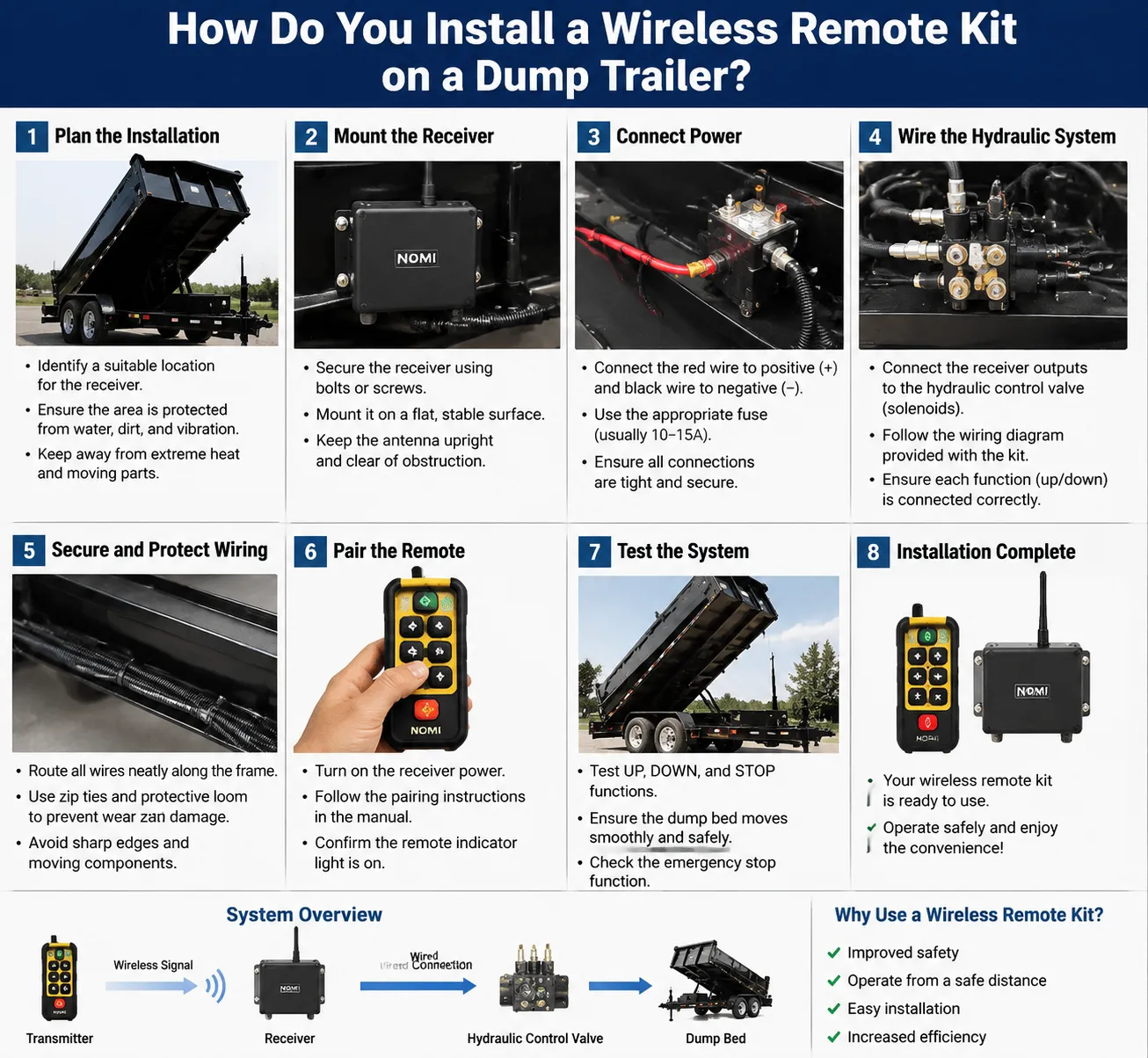
The receiver mounts near the existing pump and battery, ideally inside a weatherproof enclosure or under the trailer’s tongue box if one exists. Power leads run from the trailer’s battery positive and ground to the receiver, and output leads from the receiver connect to the relay (or relays, for double acting) that control the pump motor circuit.
Installationsschritte, durch die wir unsere Kunden führen
| Schritt | Detail |
|---|---|
| Confirm pump acting type (single vs double) | Determines relay configuration needed |
| Mount receiver in protected, accessible location | Avoid direct exposure to road spray and debris |
| Connect battery power and ground to receiver | Use appropriately gauged wire, verify solid ground connection |
| Wire relay(s) between receiver output and pump motor circuit | Match relay amperage rating to pump draw with margin |
| Pair transmitter to receiver | Follow learn-code procedure, usually a button press sequence |
| Test up function under no-load and loaded conditions | Confirm consistent operation before regular use |
| Test down function (double acting) or gravity return (single acting) | Verify smooth, controlled motion |
| Install hardwired backup switch in parallel | Provides fallback if transmitter fails |
| Waterproof and secure all connections | Dielectric grease on terminals, heat shrink on splices |
Skipping the loaded condition test is a mistake we see often. A pump might raise an empty bed just fine on wiring that’s slightly undersized, then struggle or stall when the bed carries an actual load, since higher hydraulic resistance increases current draw. Testing under realistic loaded conditions before putting the trailer into regular service catches marginal wiring problems before they become field failures.
Was sind häufige Probleme mit Funkfernbedienungen für Kippanhänger und wie lassen sie sich beheben?
Field troubleshooting for these systems follows a fairly predictable diagnostic path, and most issues resolve without needing to replace the entire remote kit.
| Symptom | Mögliche Ursache | Korrektur |
|---|---|---|
| Nothing happens when button pressed | Dead transmitter battery, unpaired receiver, blown fuse | Check battery, re-pair transmitter, inspect fuse |
| Bed raises slowly or weakly | Undersized wiring, corroded connections, weak battery on trailer | Upgrade wire gauge, clean terminals, check trailer battery voltage |
| Remote works up close but not at rated distance | Antenna damage, battery weakening, RF interference | Inspect antenna, replace battery, check for nearby interference sources |
| Down function doesn’t work (double acting) | Second relay failure, wiring fault, remote mismatched to single acting only | Verify remote is rated double acting, inspect second relay circuit |
| Bed lowers too fast (single acting) | Normal gravity-return behavior, possibly worsened by low hydraulic fluid | Check hydraulic fluid level, consider flow control valve if speed is unsafe |
| Relay clicks but pump doesn’t run | Relay contacts worn or motor circuit fault | Test relay under load, inspect motor connections and brushes |
| Intermittent operation | Loose connection, marginal wire gauge, transmitter battery fluctuation | Recheck all connections, upgrade wiring if marginal, replace battery |
The “relay clicks but pump doesn’t run” scenario deserves a specific note, since it tells you definitively that the wireless side of the system is working correctly, the transmitter, receiver, and relay all functioned as intended, meaning the problem lies entirely in the pump motor or its direct wiring, not in the remote control system itself. This diagnostic logic saves time by immediately narrowing the search to the right subsystem.
Worauf sollten Sie beim Kauf der besten Funkfernbedienung für Ihren Kippanhänger achten?
Bringing together everything above, here’s the practical checklist we walk every customer through before recommending a specific kit.
| Buying Criterion | Warum das wichtig ist |
|---|---|
| Confirmed match to single or double acting pump | Prevents the most common compatibility failure |
| Relay amperage rated at least 20% above pump draw | Prevents overheating and premature relay failure |
| Continuous duty relay construction | Withstands repeated cycling without degrading |
| IP65 or better receiver enclosure rating | Protects against road spray, dust, and weather exposure |
| Wire gauge recommendations included or verified separately | Prevents voltage drop performance issues |
| Rolling code or unique pairing technology | Prevents cross-triggering with nearby wireless equipment |
| Backup wired switch compatibility | Provides fallback if transmitter fails in the field |
| Manufacturer support for wiring diagrams specific to your pump brand | Speeds up installation, reduces wiring mistakes |
We’d add one more point that rarely appears on generic buying guides: ask whether the kit has actually been tested with your specific pump brand, since minor differences in pump wiring conventions between manufacturers (Buyers Products, Fenner, Monarch, and others) can affect which wire connects where. A supplier who can speak specifically to your pump brand’s wiring convention saves you guesswork during installation.
Wie viel kostet ein hochwertiges Funkfernbedienungsset für Kippanhänger?
Pricing varies based on single versus double acting configuration, relay amperage rating, and included components. As a 2026 market reference:
| Konfiguration | Approximate Price Range (USD) |
|---|---|
| Basic single acting kit, 100A relay, keychain transmitter | $60 to $110 |
| Single acting kit, 150A relay, IP65 receiver | $100 to $160 |
| Double acting kit, dual 100A relays, keychain transmitter | $130 to $220 |
| Double acting kit, dual 150A+ relays, rechargeable transmitter, IP65 | $200 to $320 |
| Premium kit with backup wired switch and extended warranty | $250 to $400 |
Spending slightly more for a continuous duty relay rating with real margin above your pump’s draw, and for a genuinely sealed receiver enclosure, tends to pay for itself in avoided relay replacement and moisture-related failures within the first two seasons of regular use. We’ve seen customers replace a $70 kit twice within a year, spending more in total than if they’d bought a properly rated $150 kit from the start.
Warum sollten Sie sich bei der Suche nach einer drahtlosen Fernbedienung für Ihren Kippanhänger für Nomi entscheiden?
We build our 12V dump trailer remote kits specifically around the compatibility problems that cause most returns and complaints in this category. Every kit we ship clearly states single acting or double acting compatibility on the packaging and includes a wiring diagram matched to common pump brands, not a generic diagram that leaves installers guessing at terminal assignments.
Our relays are sourced as continuous duty rated components tested under sustained load cycling that simulates a full season of daily dump cycles, not just a brief bench test at the rated amperage. We size our standard wire recommendations conservatively, meaning if your pump-to-battery distance falls at the edge of a gauge threshold, we recommend stepping up rather than cutting it close, because a slightly higher wire cost upfront costs far less than a service call to diagnose weak pump performance later.
Our receivers carry IP65 sealing as standard, not an optional upgrade, since we’ve concluded through years of field returns that trailer-mounted electronics simply need that baseline protection regardless of whether the customer expects heavy weather exposure. If you’re not sure whether your current pump is single or double acting, or what wire gauge your specific trailer setup needs, reach out to our team before ordering. A five-minute conversation upfront prevents a mismatched kit and a return shipment later.
Häufig gestellte Fragen
Can I use a single acting wireless remote on a double acting dump trailer pump?
No, a single acting remote only provides an up command through its relay output and relies on gravity for the bed to lower, while a double acting pump requires powered commands for both raising and lowering through a reversing relay setup. Using a single acting remote on a double acting pump means the down function simply won’t work through the remote, making pump type verification essential before purchase.
What wire gauge do I need for a 12V dump trailer hydraulic pump wireless remote?
Wire gauge depends on your pump’s current draw and the distance between the battery and pump, ranging from 6 AWG for smaller pumps under 80A over short distances up to 1/0 AWG for larger pumps over 150A across longer runs. Undersized wiring causes voltage drop that shows up as slow or weak bed movement even when the wireless components themselves are functioning correctly.
How far can a wireless dump trailer remote transmit reliably?
Most 433 MHz dump trailer remotes advertise 50 to 150 feet of range, though real-world performance in a working yard with metal equipment and structures typically delivers 40 to 60 percent of that advertised maximum. Treating the manufacturer’s stated range as a best-case ceiling rather than a guaranteed working distance helps set realistic expectations before purchase.
Why does my dump trailer bed lower too fast with a single acting remote?
Single acting systems rely on gravity rather than hydraulic power to lower the bed, so descent speed depends on load weight, trailer angle, and hydraulic fluid condition rather than remote control input. Checking hydraulic fluid levels can help, and trailers needing consistently controlled lowering speed regardless of load should consider upgrading to a double acting system instead.
What amperage relay do I need for my dump trailer pump motor?
Relay amperage should be rated at least 20 percent above your pump motor’s actual current draw, meaning an 80 to 100 amp pump needs a minimum 120 amp continuous duty relay for reliable long-term operation. Undersized relays overheat under repeated cycling and can weld shut in the closed position, creating a genuine safety hazard beyond simple performance problems.
How long do batteries last in a dump trailer wireless remote transmitter?
Coin cell battery transmitters typically last 6 to 12 months under regular use, AA battery models often reach 12 to 18 months, and rechargeable lithium transmitters need charging every 30 to 60 days depending on frequency of use. Cold weather reduces effective battery life across all types, so operators in colder climates should replace or charge batteries more proactively heading into winter.
Should I keep a wired backup switch after installing a wireless remote?
Yes, installing a hardwired backup switch in parallel with the wireless receiver’s output provides a reliable fallback if the transmitter battery dies or the unit gets misplaced during a job. This small addition during initial installation, typically adding minimal cost and time, prevents a completely stranded trailer in situations where wireless control becomes temporarily unavailable.
What causes a dump trailer wireless remote to work up close but fail at distance?
This pattern typically points to a weakening transmitter battery, physical antenna damage on either the transmitter or receiver, or RF interference from nearby power lines or other wireless devices operating on a similar frequency. Testing with a fresh battery first resolves the majority of these cases before assuming a hardware fault requiring replacement parts.
How do I know if my dump trailer pump is single acting or double acting?
Check whether your bed lowers entirely on its own through gravity once you release the control switch, which indicates single acting, or whether both raising and lowering require active switch input with no independent movement otherwise, which indicates double acting. Checking your pump’s part number against the manufacturer’s specification sheet resolves any remaining uncertainty quickly.
Is it worth paying more for an IP65 rated receiver on a dump trailer remote?
Yes, dump trailer receivers mount in locations exposed to road spray, dust, rain, and general weather regardless of climate, making IP65 sealing a practical baseline rather than an optional upgrade. Non-sealed receivers commonly fail within one season of regular outdoor use due to moisture ingress at the circuit board level, making the modest price difference worthwhile against replacement cost.
Machen Sie den nächsten Schritt
If you’re shopping for a wireless remote for your dump trailer and aren’t certain whether your pump is single or double acting, or what wire gauge and relay rating your specific setup needs, reach out to our team at Nomi before placing an order. We’ll help you match the correct kit to your pump brand and trailer configuration, provide wiring guidance specific to your setup, and stand behind our continuous duty relays and IP65 receivers with support that goes beyond the sale. A quick conversation upfront saves you the cost and hassle of a mismatched kit.
Quellen
- Society of Automotive Engineers, SAE J1128: Low Voltage Primary Cable Standard.
- National Fluid Power Association, Hydraulic Pump and Cylinder Performance Standards.
- Federal Communications Commission (FCC), Vorschriften für Hochfrequenzgeräte gemäß Teil 15.
- Internationale Elektrotechnische Kommission, IEC 60529: Schutzarten von Gehäusen (IP-Code).
- American Wire Gauge Standard, National Bureau of Standards Handbook.
- Occupational Safety and Health Administration, OSHA Guidelines for Vehicle and Trailer Equipment Safety.