

An industrial remote control switch crane transmitter rated IP65 gives operators wireless command over overhead cranes, hoists, and winches while keeping electronic components sealed against dust and water jets on a busy factory floor. We build ours at Nomi to survive welding sparks, coolant spray, and constant vibration, and after years of shipping units to steel mills, port terminals, and precast concrete plants, the transmitter is only as good as its sealing, its button feedback, and the support behind it.
If your project requires the use of Industrial Remote Control, you can contact us for a free quote.
What Is an Industrial Remote Control Switch Crane Transmitter and How Does It Work?
A crane transmitter is the handheld or belt-mounted controller an operator carries to send radio signals to a receiver mounted on the crane’s control panel. Press a button, and the transmitter sends a coded RF signal (usually in the 315 MHz, 433 MHz, or 2.4 GHz band) to the receiver, which then closes a relay or triggers a PLC input that drives the hoist motor, trolley motor, or bridge motor.
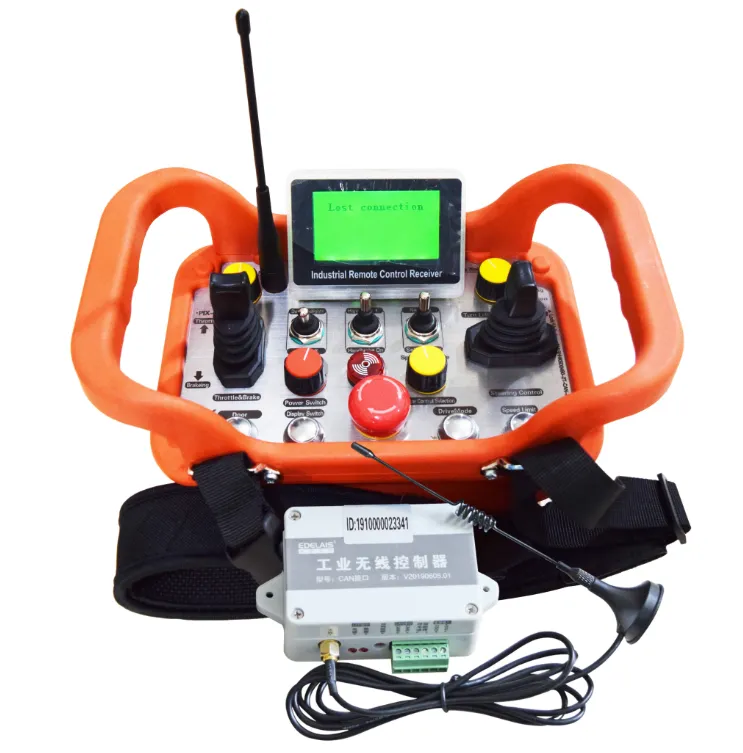
The “switch” part of the name refers to the physical toggle or push-button switches inside the case that operators press with a thumb or finger. Unlike a touchscreen pendant, a switch-based transmitter gives tactile confirmation, something plant operators wearing gloves genuinely need. When we interview crane operators at customer sites, the number one complaint about touchscreen remotes is that they can’t feel whether a command registered. A mechanical switch removes that doubt.
Inside the enclosure sits a printed circuit board with a microcontroller, an RF transmission module, an antenna, and a battery (typically a rechargeable lithium or 12V alkaline pack). The transmitter encodes each button press with a rolling code or fixed code, then broadcasts it. The receiver decodes the signal, checks it against a paired address code, and activates the corresponding output relay.
Why Wireless Control Replaced Wired Pendants
Older cranes used pendant stations connected by a hanging cable. That cable would fray, tangle, and eventually short out from repeated flexing. A wireless transmitter eliminates the cable entirely, letting the operator move freely around the load, watch the hook from multiple angles, and stay clear of pinch points. Plants that switched from pendant to wireless report fewer near-miss incidents simply because the operator isn’t standing directly under the load path to hold a cable.
Why Does IP65 Rating Matter for Factory Crane Control Systems?
IP65 means the enclosure is completely dust-tight and can withstand low-pressure water jets from any direction without harmful ingress. That rating comes from IEC 60529, the international standard that grades enclosure protection with two digits: the first for solid particle protection, the second for liquid protection.
| IP Rating | Solid Protection | Liquid Protection | Typical Use Case |
|---|---|---|---|
| IP54 | Limited dust protection (no harmful deposit) | Splashing water from any direction | Light indoor assembly lines |
| IP65 | Complete dust-tight | Low-pressure water jets, any direction | Foundries, ports, outdoor gantry cranes |
| IP66 | Complete dust-tight | High-pressure, high-volume water jets | Wash-down areas, food processing plants |
| IP67 | Complete dust-tight | Temporary immersion up to 1 meter | Flood-prone sites, mining pits |
For most factory and yard crane applications, IP65 is the practical sweet spot. It costs less to manufacture than IP66 or IP67 while covering the realistic hazards a transmitter faces: metal dust from grinding, cement powder, rain, and hose-down cleaning around the workstation. We’ve tested our own units by running them through a swinging arm spray chamber at 12.5 liters per minute, and the seals around the button membrane and battery compartment are what determine pass or fail, not the plastic shell itself.
What Actually Fails First in a Non-Sealed Transmitter
When we tear down returned units that weren’t IP65 rated, the failure almost always starts at the same three points:
- The battery door gasket compresses over time and stops sealing.
- The rubber membrane over the buttons develops micro-tears from repeated flexing.
- The antenna feed-through hole was sealed with silicone that cracked after thermal cycling.
A genuine IP65 transmitter uses a compression-molded silicone gasket around the entire case seam, a one-piece membrane keypad bonded with industrial adhesive, and a potted antenna connector. If a supplier can’t show you the gasket cross-section or explain how the antenna seal is made, the “IP65” claim on the spec sheet probably hasn’t been independently tested.
What Are the Core Components Inside a Crane Transmitter?
Every reliable transmitter shares a common architecture, though quality varies enormously between manufacturers. Understanding the parts helps buyers ask the right questions before purchase.
| Component | Function | Common Failure Point |
|---|---|---|
| Enclosure shell | Physical protection, ergonomic grip | Cracking from drops |
| Membrane keypad | Tactile input, seals buttons | Tearing, loss of click feel |
| PCB and microcontroller | Encodes signals, manages logic | Solder joint fatigue from vibration |
| RF module and antenna | Transmits coded signal to receiver | Weak range from poor antenna tuning |
| Battery | Powers the unit | Capacity fade, corrosion at terminals |
| LED indicators | Shows power, low battery, pairing status | Dim or dead LED from age |
| Emergency stop button | Cuts all crane functions immediately | Contact welding from overuse |
The emergency stop button deserves special mention. On a factory transmitter, this red mushroom-head switch must break the circuit through a hardwired, fail-safe relay, not just send a “stop” RF command. If the transmitter loses signal or the battery dies, the crane must stop automatically through the receiver’s watchdog timer. This is a non-negotiable safety feature, and we won’t ship a unit that doesn’t have it.
Which Industries Rely on Industrial Crane Transmitters?
Crane remote controls show up wherever heavy loads move overhead. The specific demands differ by sector, and matching the transmitter to the environment prevents premature failure.
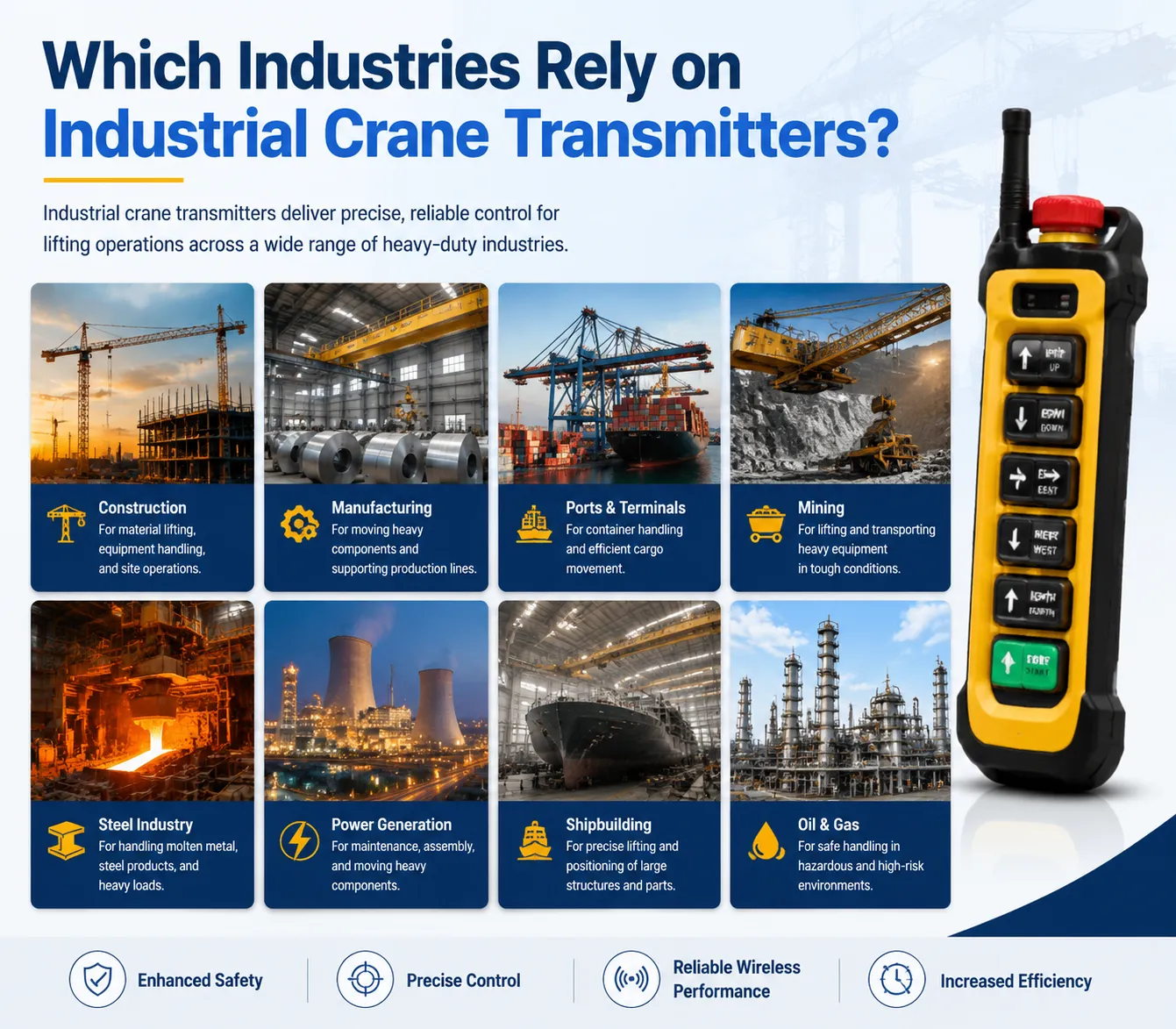
| Industry | Typical Crane Type | Key Transmitter Requirement |
|---|---|---|
| Steel and metal fabrication | Overhead bridge cranes, gantry cranes | Heat resistance, vibration tolerance |
| Ports and shipping terminals | Container gantry cranes, ship-to-shore cranes | Long range (300m+), saltwater corrosion resistance |
| Precast concrete and cement | Tower cranes, gantry lifters | Dust-tight sealing, robust drop resistance |
| Mining and quarrying | Mobile cranes, winches | Wide temperature range, high IP rating |
| Food and beverage processing | Monorail hoists | Frequent wash-down tolerance, chemical resistance |
| Warehousing and logistics | Jib cranes, electric hoists | Multi-crane pairing, lightweight design |
| Shipbuilding | Gantry and tower cranes | Long-distance line-of-sight range |
We supply plants in nearly all of these sectors, and the recurring lesson is that no single transmitter fits every environment perfectly. A port terminal in a humid coastal climate needs corrosion-resistant contacts and a higher IP rating than a dry indoor warehouse. Buyers who choose a “one size fits all” transmitter often end up replacing units within eighteen months because the environment exceeded the design tolerance.
How Do You Choose the Right Crane Transmitter for Your Application?
Selecting a transmitter comes down to five practical questions: how many crane functions need control, how far the operator will stand from the receiver, how harsh the environment is, how many cranes need to be operated from one location, and what redundancy is required for safety.
| Factor | What to Check | Why It Matters |
|---|---|---|
| Number of channels | 4, 6, 8, 10, or 12 button functions | Must match hoist, trolley, and bridge motion directions plus auxiliary functions |
| Control speed | Single-speed, two-speed, or stepless (variable) | Determines precision when positioning loads |
| Operating range | Rated distance in open air (150m to 800m typical) | Real-world range drops with obstructions, metal structures |
| Frequency band | 433 MHz, 868 MHz, 2.4 GHz | Affects interference resistance and regional licensing |
| Battery type | Rechargeable lithium vs replaceable alkaline | Impacts downtime and maintenance cost |
| IP rating | IP54 to IP67 | Matches environmental exposure |
| Pairing capacity | Single receiver vs multi-crane switching | Needed when one operator runs multiple cranes |
We generally recommend that buyers oversize the channel count by at least two functions beyond current needs. Plants that add a second hoist speed or an auxiliary function later often discover their transmitter has no spare buttons, forcing a full system replacement instead of a simple reprogram.
Single-Speed vs Two-Speed vs Variable-Speed Transmitters
A single-speed transmitter sends an on/off signal, moving the crane at one fixed speed. This works for basic lifting tasks where precision isn’t critical.
A two-speed transmitter uses a light or firm button press to select slow or fast motion, giving operators fine control near the final placement point while still moving quickly across long distances. Most fabrication shops we work with prefer two-speed as the practical minimum for safety and productivity.
A variable-speed (stepless) transmitter sends an analog or PWM signal that lets the operator dial in any speed between zero and maximum, similar to a car’s accelerator pedal. This is standard on tower cranes and applications where load swing control is critical, such as handling glass panels or precast concrete elements where sudden stops cause dangerous pendulum motion.
What Safety Standards and Certifications Should a Crane Transmitter Meet?
Compliance documentation separates industrial-grade equipment from consumer-grade imitations. Before purchasing, buyers should request copies of the actual test reports, not just a printed certification logo on the packaging.
| Standard | Region | What It Covers |
|---|---|---|
| CE (EMC and RED directives) | European Union | Electromagnetic compatibility, radio equipment safety |
| FCC Part 15 | United States | Radio frequency interference limits |
| IEC 60529 | International | Ingress protection (IP) rating verification |
| ISO 13849 | International | Safety-related parts of control systems (relevant to E-stop circuits) |
| RoHS | European Union | Restriction of hazardous substances |
| ATEX (for explosive atmospheres) | European Union | Equipment used in potentially explosive environments |
For plants in the oil, gas, or grain handling sectors, ATEX or IECEx certification becomes mandatory since a spark from an uncertified transmitter near combustible dust or vapor is a genuine explosion hazard. We’ve turned down orders where a customer requested a standard IP65 unit for a location that legally required ATEX-rated equipment, because shipping the wrong product would put their workers at risk regardless of what the purchase order said.
How Does Radio Frequency Selection Affect Crane Remote Performance?
Frequency choice determines how well a transmitter resists interference and how far its signal travels. The three common bands each carry tradeoffs.
433 MHz offers good penetration through metal structures and walls, making it popular for indoor factory cranes surrounded by steel beams and machinery. Range typically runs 150 to 300 meters in open conditions, less indoors with obstructions.
868 MHz (used mainly in Europe) sits in a licensed-light band with lower congestion than 433 MHz, giving more reliable performance in facilities with many other RF devices operating nearby.
2.4 GHz provides higher data rates and supports more sophisticated encoding, useful for transmitters with many channels or those integrated with telemetry feedback. However, 2.4 GHz has shorter range through solid obstructions and shares spectrum with WiFi and Bluetooth devices, which can cause interference in facilities dense with wireless equipment.
We generally steer factory customers toward 433 MHz or 868 MHz for standard bridge and gantry cranes, reserving 2.4 GHz for applications needing bidirectional data such as load weight display or diagnostic feedback on the transmitter screen.
How Rolling Code Technology Prevents Signal Interference
A rolling code transmitter changes its transmitted code sequence with every button press, following an algorithm synchronized between transmitter and receiver. This prevents a nearby transmitter (say, from a different crane on the same production floor) from accidentally triggering the wrong receiver, and it also blocks basic signal replay attempts. Fixed code transmitters, by contrast, send the same code every time, which is cheaper to produce but carries a real risk of cross-triggering when multiple cranes operate close together. Any factory running more than one crane in the same hall should insist on rolling code technology as a baseline requirement, not an upgrade option.
How Do You Install and Maintain a Crane Remote Control System?
Installation starts with mounting the receiver in a location shielded from direct water spray and excessive heat, ideally inside the crane’s existing electrical panel enclosure. The receiver connects to the crane’s motor contactors, typically replacing or supplementing an existing pendant control wiring.
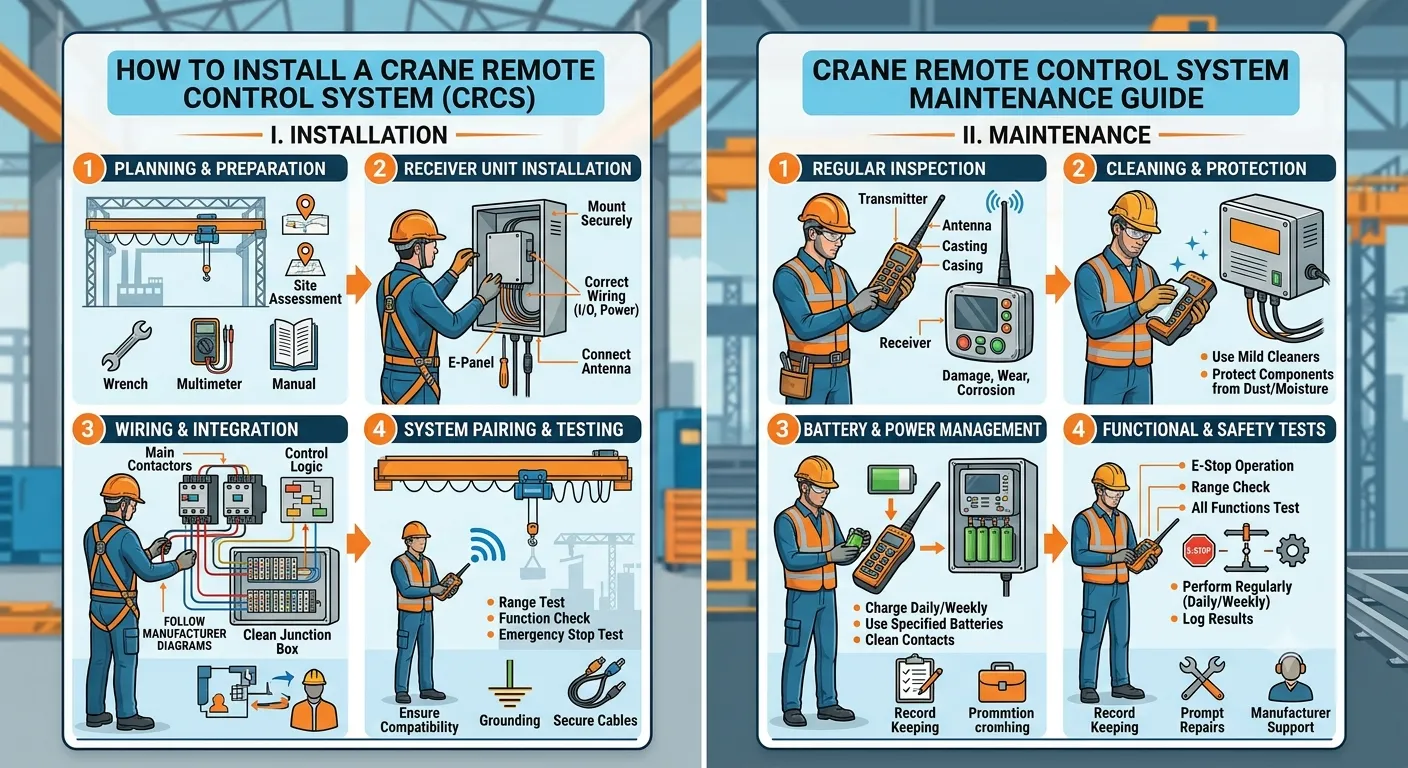
Pairing the transmitter to the receiver usually involves a simple procedure: powering the receiver, pressing a “learn” button, then pressing the corresponding transmitter button within a set time window (often 10 to 30 seconds) so the receiver stores the matching address code.
Maintenance Checklist We Recommend to Every Customer
| Task | Frequency | Purpose |
|---|---|---|
| Visual inspection of casing for cracks | Weekly | Catch seal damage before water ingress occurs |
| Battery voltage check | Monthly | Prevent unexpected shutdown mid-operation |
| Emergency stop function test | Weekly | Confirm fail-safe circuit still cuts power correctly |
| Button response test (all channels) | Monthly | Identify sticking or unresponsive switches early |
| Antenna and gasket inspection | Quarterly | Detect wear that reduces range or seal integrity |
| Firmware/pairing recheck after battery replacement | As needed | Ensure code synchronization remains intact |
Plants that follow a documented maintenance schedule report transmitter service life averaging four to six years, compared to roughly two years for units that receive no scheduled inspection. The single most common cause of early failure we see in field returns is a swollen or leaking battery that was never checked until it damaged the internal PCB.
What Are Common Problems and Troubleshooting Tips for Crane Transmitters?
Operators encounter a fairly predictable set of issues, and most have straightforward fixes before a technician needs to be called.
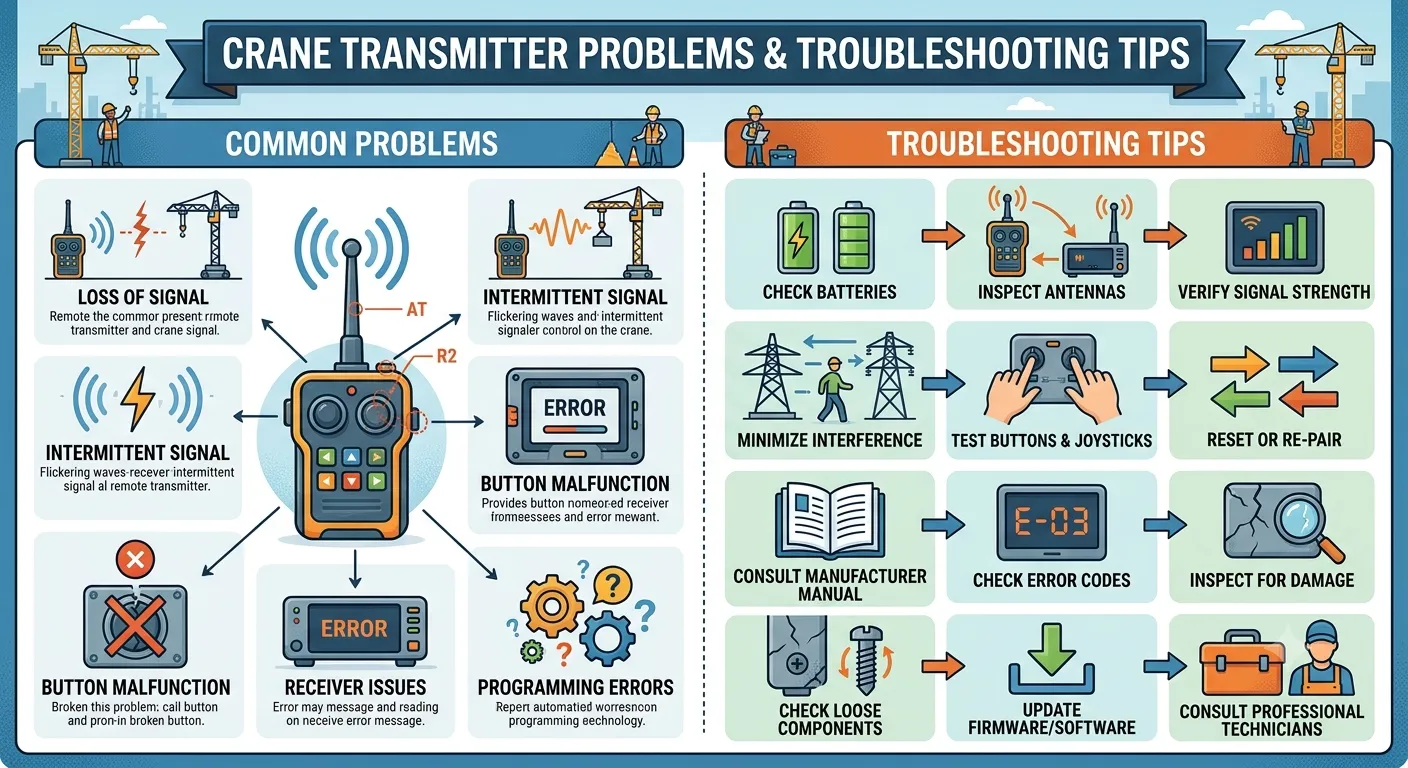
| Symptom | Likely Cause | Fix |
|---|---|---|
| Crane doesn’t respond at all | Dead battery, receiver power loss, or unpaired code | Check battery voltage, confirm receiver has power, re-pair if necessary |
| Intermittent signal loss | Weak battery, antenna damage, RF interference from nearby equipment | Replace battery, inspect antenna, relocate receiver away from interference sources |
| Reduced range | Antenna seal degraded, obstruction between units, low battery | Inspect antenna, clear line of sight, replace battery |
| One button stops working | Membrane wear, water ingress under that specific switch | Inspect and replace membrane keypad |
| Crane moves in wrong direction | Wiring reversed at receiver terminal, or channel mismapping | Verify receiver wiring against transmitter channel diagram |
| Emergency stop doesn’t cut power | Relay contact welded shut, wiring fault | Immediately remove crane from service, replace relay |
We always tell customers: if the emergency stop test ever fails, that crane stops operating that same day, no exceptions. Everything else on this list is a maintenance issue; the E-stop is a life-safety issue.
How Much Does an Industrial Crane Remote Control System Cost?
Pricing depends on channel count, IP rating, certification level, and order volume. As a general market reference for 2026 pricing:
| Configuration | Approximate Price Range (USD, per set) |
|---|---|
| 4-channel, single-speed, IP54 | $60 to $120 |
| 6-channel, two-speed, IP65 | $130 to $260 |
| 8-channel, two-speed, IP65, rolling code | $220 to $400 |
| 10 to 12-channel, variable-speed, IP66, ATEX-rated | $450 to $900+ |
Bulk factory orders (50+ units) typically bring per-unit costs down 15 to 30 percent depending on customization requirements such as branded casing, custom button labeling, or specific frequency licensing for the destination country. Buyers should also factor in the cost of receivers, since some suppliers price transmitters and receivers separately while others bundle them as a matched set. We always recommend clarifying total system cost including receiver, mounting hardware, and spare batteries before comparing quotes across suppliers, because a low transmitter price sometimes hides an inflated receiver cost.
Why Choose Nomi as Your Crane Transmitter Manufacturer?
We’ve spent years designing, testing, and refining industrial remote controls specifically for harsh factory conditions, and that hands-on experience shapes every product decision we make. Our IP65 crane transmitters go through drop testing from 1.5 meters onto concrete, spray chamber testing per IEC 60529, and continuous vibration testing that simulates years of daily crane operation compressed into weeks.
What sets our approach apart isn’t just the hardware. Our engineering team responds directly to customer feedback from the field, meaning when a customer in a cement plant reported button fatigue after eighteen months of heavy use, we redesigned the membrane keypad material within that same product line rather than waiting for a full model refresh cycle. We manufacture in-house rather than outsourcing PCB assembly, which lets us maintain consistent quality control batch to batch, something buyers rarely get visibility into when comparing suppliers purely on spec sheets.
We also provide direct factory support: pairing assistance, replacement part availability for units up to eight years old, and custom channel configuration for OEM crane manufacturers who need transmitters matched to specific control panel layouts. If you’re evaluating suppliers, ask for actual test videos, not just certificates, and ask how long they’ve supported previous product generations. Those two questions reveal more about long-term reliability than any spec sheet comparison.
Frequently Asked Questions
What does IP65 mean on a crane remote control?
IP65 means the transmitter enclosure is fully dust-tight and protected against low-pressure water jets from any direction, based on IEC 60529 testing. For factory and outdoor crane use, this rating covers the realistic hazards of dust, rain, and hose-down cleaning without requiring the higher cost of IP66 or IP67 protection.
How far can an industrial crane transmitter operate from the receiver?
Most industrial crane transmitters operate reliably between 150 and 300 meters in open, unobstructed conditions, with some long-range models reaching 500 to 800 meters for port and shipyard cranes. Actual range drops indoors due to metal structures, concrete walls, and RF interference from nearby machinery.
Can one crane transmitter control multiple cranes?
Yes, multi-crane pairing transmitters exist and let one operator switch control between two or more cranes using a selector function on the same handset. This setup requires a receiver on each crane paired to unique address codes, and the transmitter typically shows which crane is currently active through an LED or display indicator.
What is the difference between rolling code and fixed code transmitters?
Rolling code transmitters change the transmitted signal pattern with every button press, preventing cross-triggering between nearby cranes and blocking basic signal interception. Fixed code transmitters send identical signals every time, which costs less but creates real interference risk in facilities operating multiple cranes in close proximity.
How long does the battery last on an industrial crane transmitter?
Rechargeable lithium battery transmitters typically run 15 to 30 days on a single charge under normal daily use, while replaceable alkaline battery models often last 3 to 6 months depending on usage frequency. Battery life shortens significantly in cold environments below 0°C, so plants in unheated warehouses should budget for more frequent replacement.
Is an emergency stop button required on crane remote transmitters?
Yes, virtually all industrial safety standards require a hardwired emergency stop function on crane transmitters that cuts power through a fail-safe relay independent of the radio signal. This ensures the crane stops immediately even if the transmitter loses battery power or radio connection, which is why E-stop testing should happen weekly.
What frequency band is best for factory crane remote controls?
433 MHz and 868 MHz bands generally perform best for factory crane applications since they penetrate steel structures more effectively than 2.4 GHz while avoiding congestion from WiFi and Bluetooth devices. 2.4 GHz suits applications needing higher data transfer for feedback displays but experiences more interference in equipment-dense facilities.
How often should crane transmitters be replaced?
Well-maintained industrial crane transmitters typically last 4 to 6 years with regular battery checks and seal inspections, while neglected units often fail within 2 years due to battery corrosion or membrane wear. Replacement timing should follow performance testing results rather than a fixed calendar schedule, since usage intensity varies significantly between facilities.
Can crane transmitters work in explosive or hazardous atmospheres?
Standard IP65 transmitters are not certified for explosive atmospheres and should never be used in grain silos, chemical plants, or oil facilities without ATEX or IECEx certification. Facilities with combustible dust or vapor hazards must specifically request explosion-proof rated transmitters, since a standard unit’s internal spark risk becomes a genuine safety hazard in these environments.
What causes a crane remote control to lose signal randomly?
Random signal loss usually traces back to a weakening battery, a damaged antenna seal allowing moisture ingress, or RF interference from nearby equipment operating on overlapping frequencies. Testing battery voltage and inspecting the antenna gasket resolves the majority of intermittent connection complaints we handle from field customers.
Take the Next Step
If your plant is still relying on aging pendant controls or a transmitter that keeps failing seals and buttons, our engineering team at Nomi can review your current crane specifications and recommend a configuration matched to your actual operating conditions, not a generic catalog listing. Reach out for a technical consultation, request test reports and sample units before committing to a bulk order, and let our field experience help you avoid the downtime that comes from choosing the wrong transmitter the first time.
Sources
- International Electrotechnical Commission, IEC 60529: Degrees of Protection Provided by Enclosures (IP Code)
- Federal Communications Commission, FCC Part 15 Radio Frequency Devices Regulations
- European Commission, CE Marking Radio Equipment Directive (RED) 2014/53/EU
- International Organization for Standardization, ISO 13849-1: Safety of Machinery, Safety-Related Parts of Control Systems
- Occupational Safety and Health Administration (OSHA), Overhead and Gantry Cranes Standard 1910.179
- ATEX Directive 2014/34/EU, Equipment for Explosive Atmospheres.