

A crane truck remote control with joystick and proportional functions gives operators the precision to modulate boom speed, load swing, and outrigger positioning through a single analog lever rather than a fixed on/off button, and that difference in control resolution is what separates a smooth pick-and-place operation from a jerky one that stresses the hydraulic system. At Nomi, we’ve spent years building these systems for boom truck manufacturers, knuckle boom crane operators, and mobile crane rental fleets, and the pattern we see repeatedly is this: operators who switch from button-style transmitters to proportional joystick control report fewer load swing incidents within the first month, simply because the truck responds to how hard they push the lever instead of jumping to full speed instantly.
If your project requires the use of Crane Truck Remote Control, you can contact us for a free quote.
What Is a Crane Truck Remote Control and How Does Proportional Control Work?
A crane truck remote control lets an operator stand at a safe distance from the vehicle and command boom extension, rotation, winch lift, and outrigger movement without climbing into a cab or standing near the load path. On truck-mounted cranes, knuckle boom loaders, and articulated crane trucks, this remote typically pairs a handheld or vest-mounted transmitter with a receiver wired into the truck’s hydraulic valve bank.
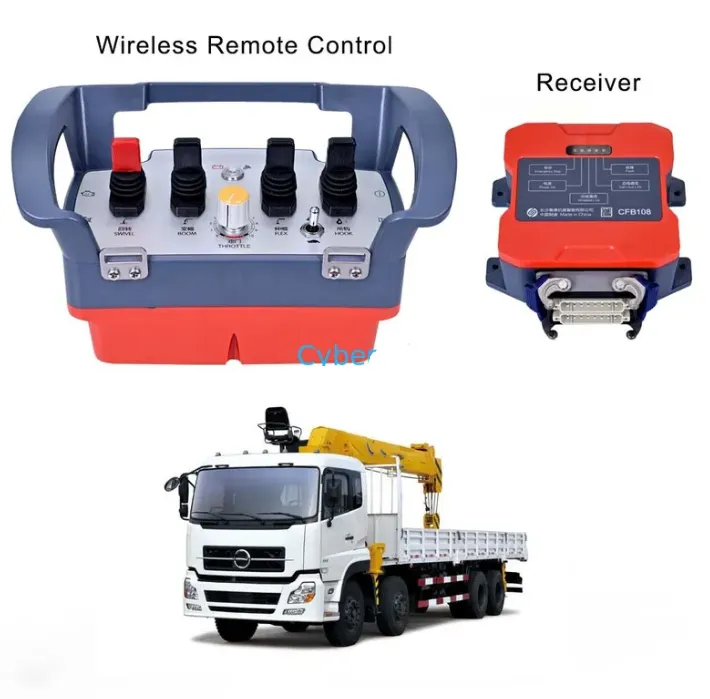
Proportional control means the output speed corresponds directly to how far the operator moves the joystick or lever, not just whether the button is pressed or released. Push the joystick 20 percent of its travel, and the hydraulic valve opens 20 percent, moving the boom slowly. Push it fully forward, and the valve opens completely for maximum speed. This mirrors exactly how an operator sitting inside the cab would feel through a mechanical lever, which is why proportional remotes feel intuitive to experienced crane operators almost immediately.
The technical mechanism behind this involves the joystick sending a variable voltage or PWM (pulse-width modulation) signal that scales with lever displacement. That signal transmits wirelessly to the receiver, which converts it into a proportional current output driving the hydraulic proportional valve’s solenoid. The valve spool then opens incrementally rather than snapping fully open, giving the smooth acceleration and deceleration curve that heavy load handling demands.
Why Button-Style Control Falls Short for Crane Trucks
A standard push-button transmitter sends a binary signal: on or off, full speed or stop. For simple hoist operations lifting fixed loads, this can be adequate. But crane trucks handling variable loads, working near power lines, or positioning materials in tight yards need finer control than on/off buttons allow. Operators using button-only systems often “pulse” the button rapidly to approximate slower movement, which actually causes more mechanical stress on the hydraulic valves and more load swing than a properly proportional system would produce. We’ve watched experienced operators do this pulsing technique out of habit even when better equipment is available, simply because that’s what they learned on older trucks.
What’s the Real Difference Between Joystick and Push-Button Crane Remotes?
The distinction goes beyond the physical shape of the control. It affects safety, load control precision, hydraulic component wear, and ultimately how fast a job gets done without incident.
| Feature | Push-Button Remote | Joystick Proportional Remote |
|---|---|---|
| Speed control | Fixed single or dual speed | Infinitely variable within valve range |
| Load swing management | Higher risk from abrupt starts/stops | Smoother acceleration reduces pendulum effect |
| Learning curve for new operators | Shorter initial learning time | Slightly longer, but more intuitive long-term |
| Hydraulic valve wear | Higher due to repeated full-flow shocks | Lower due to gradual valve opening |
| Best suited for | Basic hoist lifting, repetitive fixed loads | Boom trucks, knuckle cranes, precision placement work |
| Typical cost | Lower | 20-40% higher due to additional electronics |
| Multi-axis control | Usually single function per button | Joystick can control 2 axes simultaneously (X/Y movement) |
The multi-axis point deserves attention because it’s often overlooked in buying decisions. A single proportional joystick can control boom extend/retract on one axis and boom up/down on the perpendicular axis simultaneously, meaning the operator makes one smooth diagonal motion instead of pressing two separate buttons sequentially. On a busy job site, this cuts cycle time noticeably, something fleet managers we work with have measured directly through job completion logs.
How Do You Choose Between Single-Axis and Multi-Axis Joystick Configurations?
Crane truck remotes typically offer either single-axis joysticks (one lever per function) or multi-axis joysticks (one lever controlling two or more functions through its X and Y movement). The right choice depends on how many simultaneous functions the operator realistically needs to coordinate.
| Configuration | Functions Controlled | Common Application |
|---|---|---|
| Single-axis joystick x1 | One hydraulic function (e.g., winch up/down) | Simple hoist-only trucks |
| Single-axis joystick x2 | Two independent functions | Basic knuckle boom loaders |
| Dual-axis joystick x1 | Two functions on one lever (X and Y) | Boom extend/retract + boom lift/lower |
| Dual-axis joystick x2 | Four functions across two levers | Full articulated crane truck control |
| Dual-axis + rotary knob combo | Four+ functions plus rotation speed adjustment | Heavy knuckle boom cranes with slewing function |
We generally recommend dual-axis configuration for any truck with an articulated or knuckle boom, since operators handling loads near structures or power lines need to combine boom extension and lift angle adjustments in one fluid motion rather than stopping one function to start another. Trucks with simpler telescopic booms and no articulation joint can often manage well with single-axis joysticks paired with separate buttons for auxiliary functions like outrigger deployment.
What Hydraulic Valve Types Work with Proportional Crane Remotes?
Not every hydraulic system on a crane truck is built to accept proportional signals out of the box, and this is one of the most common integration mistakes we see when customers retrofit older trucks.
| Valve Type | Compatible with Proportional Control | Notes |
|---|---|---|
| Solenoid on/off valve | No | Only accepts binary open/close signal |
| Proportional solenoid valve | Yes | Designed for variable current input |
| Load-sensing proportional valve | Yes | Adjusts flow based on load pressure feedback |
| Manual override valve (with electric actuator retrofit) | Sometimes | Requires actuator upgrade to accept proportional signal |
| Pilot-operated proportional valve | Yes | Common on larger knuckle boom cranes |
Retrofitting an older truck that only has on/off solenoid valves means the proportional joystick’s variable signal gets wasted, since the valve can only respond to full open or full closed regardless of what signal it receives. In these cases, the truck’s hydraulic valve bank needs replacement or upgrade before a proportional remote delivers any real benefit. We always ask customers for their existing valve specifications before recommending a proportional system, because selling a proportional transmitter to run on incompatible valves just sets up an unhappy customer and a return shipment.
How PWM Signal Frequency Affects Valve Response Smoothness
Proportional valves respond to PWM signals typically ranging from 100 Hz to 300 Hz. A lower frequency can cause the valve spool to hunt or oscillate slightly, producing a jerky feel even though the joystick input was smooth. Higher frequency signals produce smoother valve modulation but require more sophisticated electronics in both the transmitter and receiver to generate cleanly. Quality proportional receivers allow frequency adjustment during commissioning so technicians can tune the response to match the specific valve manufacturer’s optimal range, something worth confirming exists in any system before purchase.
What Radio Technology Do Crane Truck Remotes Use for Reliable Signal Transmission?
Crane truck operations often happen in electrically noisy environments, near substations, construction sites with multiple radio devices, or in dense urban areas with heavy wireless traffic. The radio technology inside the transmitter determines whether the system holds a reliable connection under these conditions.
| Radio Technology | Frequency Range | Strength | Limitation |
|---|---|---|---|
| Standard FSK/ASK | 433/868 MHz | Simple, cost-effective, good range | More vulnerable to interference |
| Frequency Hopping Spread Spectrum (FHSS) | 2.4 GHz | Resistant to interference, hops channels rapidly | Shorter range through obstacles |
| Direct Sequence Spread Spectrum (DSSS) | 2.4 GHz | Strong noise immunity | Higher power consumption |
| Dual-band systems | 433 MHz + 2.4 GHz | Combines penetration and interference resistance | Higher cost, more complex pairing |
For crane trucks that frequently work near cell towers, power substations, or other radio-heavy environments, we push customers toward FHSS-based systems specifically because the frequency hopping pattern makes it nearly impossible for a single interference source to hold a lock on the signal long enough to disrupt operation. Standard fixed-frequency systems work fine in quieter rural or industrial yard settings but show their weakness the moment a job moves into a congested urban work zone.
What Safety Features Should a Proportional Crane Remote Include?
Beyond basic stop-start functionality, a properly engineered proportional crane truck remote incorporates multiple layers of protection designed specifically around the risks of mobile crane operation, which differ meaningfully from fixed overhead crane risks.
| Safety Feature | Function | Why It Matters for Crane Trucks |
|---|---|---|
| Fail-safe neutral return | Joystick springs back to center, stopping motion, if released or damaged | Prevents runaway boom movement if operator loses grip |
| Emergency stop button | Hardwired cutoff independent of RF signal | Immediate stop regardless of transmitter state |
| Ramp-up/ramp-down acceleration limiting | Prevents sudden jerk even at full joystick deflection | Reduces load swing and structural stress |
| Dead-man switch | Requires continuous operator engagement to function | Stops all movement if operator becomes incapacitated |
| Radio link loss timeout | Automatically halts crane if signal drops beyond set duration | Prevents uncontrolled movement from lost connection |
| Overload protection interface | Communicates with truck’s load moment indicator | Prevents remote-commanded movement that would exceed rated capacity |
| Anti-two-block protection tie-in | Cuts hoist function before block contacts boom tip | Prevents cable damage and load drop |
The overload protection interface is one area where we see meaningful differences between budget transmitters and properly engineered systems. A remote that simply sends movement commands without any communication back from the truck’s load moment indicator system offers no protection against an operator inadvertently commanding a movement that tips the load moment into an unsafe range. Better systems establish a data link between the receiver and the truck’s existing LMI (load moment indicator), automatically inhibiting further boom extension or load lift when the system approaches its rated capacity curve.
How Does Ergonomic Design Affect Operator Fatigue and Accuracy?
Crane truck operators often work full shifts holding the transmitter, and the physical design of the unit directly affects both fatigue and precision over hours of continuous use. This gets overlooked in spec sheet comparisons but matters enormously in real-world feedback.
Belt-mounted transmitters with a chest harness distribute weight across the shoulders rather than the wrist, reducing fatigue during long shifts. Handheld units without a harness concentrate weight on the forearm and wrist, which becomes noticeably uncomfortable after several hours, particularly in cold weather when grip strength naturally decreases.
Joystick resistance and travel distance also matter more than most buyers initially realize. A joystick with too little resistance can register unintended movement from normal hand tremor or truck vibration transmitted through the operator’s body, while a joystick with too much resistance tires the thumb or fingers over a full shift. We’ve found that joysticks offering adjustable spring tension, letting individual operators calibrate resistance to their preference, get noticeably higher satisfaction ratings in post-installation surveys than fixed-tension units.
Display Screens and Feedback Information Operators Actually Use
Many modern proportional transmitters include a small LCD or OLED screen showing battery level, active function, load weight (when tied into a load cell), and boom angle. Operators consistently tell us the two pieces of information they check most during actual operation are battery percentage and load weight, while boom angle and other diagnostic data get checked mainly during setup rather than active lifting. This matters for manufacturers designing screen layouts, since burying critical information behind menu screens rather than showing it on the default display adds unnecessary glance time during active load handling.
What Certifications and Compliance Standards Apply to Crane Truck Remotes?
Regulatory compliance isn’t optional for equipment controlling load-bearing machinery, and buyers should request actual documentation rather than accepting a logo printed on packaging.
| Standard | Governing Body | Coverage |
|---|---|---|
| ISO 13849-1 | International Organization for Standardization | Safety-related control system performance levels |
| EN 13000 | European Committee for Standardization | Mobile crane safety requirements |
| ANSI/ASME B30.5 | American Society of Mechanical Engineers | Mobile and locomotive crane safety standards |
| CE Marking (RED Directive) | European Union | Radio equipment safety and EMC compliance |
| FCC Part 15/90 | United States | RF interference and land mobile radio compliance |
| OSHA 1926.1400 | Occupational Safety and Health Administration | Crane and derrick safety in construction |
ISO 13849-1 deserves particular attention for proportional systems because it defines Performance Level (PL) ratings for safety functions like emergency stop and fail-safe neutral return. A crane truck remote claiming PLd or PLe compliance has undergone specific reliability testing on its safety circuit architecture, meaning the emergency stop and neutral-return functions have documented failure rate calculations behind them, not just a marketing claim. When we quote proportional systems for customers in regulated industries like utility line work or municipal construction, this documentation often becomes the deciding factor in the purchase, more than price or feature count.
How Do You Install and Commission a Crane Truck Remote System?
Installation on a crane truck differs from a simple overhead crane retrofit because the receiver must interface with the truck’s existing hydraulic control valves, often requiring coordination with the truck’s electrical harness and CAN bus system on newer vehicles.
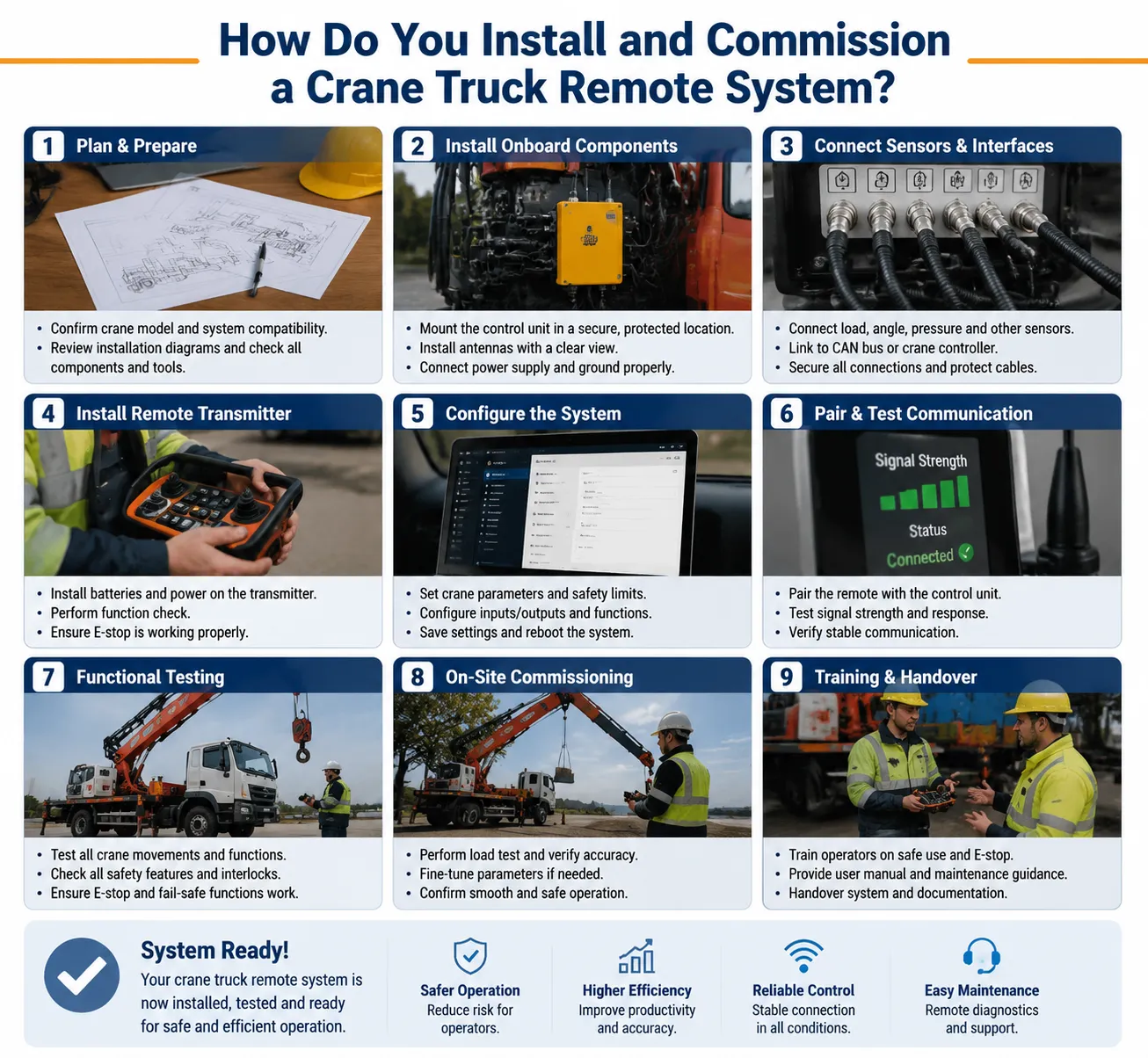
The typical installation sequence starts with mounting the receiver in a protected location within the truck’s control cabinet, away from direct exposure to hydraulic fluid leaks or road debris. Technicians then wire the receiver’s proportional outputs to the corresponding solenoid valve inputs, matching each joystick axis to its intended hydraulic function.
Commissioning Steps That Prevent Field Problems
| Step | Purpose |
|---|---|
| Calibrate joystick neutral position | Ensures zero output when joystick is centered, preventing drift |
| Set minimum and maximum current thresholds | Matches valve’s actual operating range to joystick travel |
| Test ramp rate settings | Confirms acceleration/deceleration feels smooth, not abrupt |
| Verify fail-safe neutral return under simulated signal loss | Confirms crane stops safely if connection drops |
| Test emergency stop response time | Confirms hardwired cutoff functions independent of RF |
| Range test at maximum expected working distance | Confirms reliable signal at real job site distances, not just close range |
| Document configuration settings | Provides baseline for future troubleshooting or replacement |
Skipping the minimum/maximum current threshold calibration is the single most common commissioning mistake we encounter during field support calls. If this step is rushed, the joystick’s full range of motion might only produce a fraction of the valve’s actual flow range, making the crane feel sluggish and unresponsive even though the hardware itself is functioning correctly. A properly calibrated system should let the operator access the full practical speed range of the crane across the joystick’s full travel distance.
What Maintenance Keeps a Proportional Crane Remote Reliable Long-Term?
Proportional systems have more sensitive electronics than simple button transmitters, which means maintenance routines need slight adjustments compared to basic remote control upkeep.
| Maintenance Task | Frequency | What It Prevents |
|---|---|---|
| Joystick centering and drift check | Weekly | Prevents unintended slow movement from miscalibrated neutral point |
| Battery voltage and charging contact inspection | Weekly | Avoids mid-shift power loss |
| Enclosure seal and gasket check | Monthly | Prevents hydraulic fluid or moisture ingress affecting electronics |
| Receiver connection and wiring inspection | Monthly | Catches loose connections before intermittent faults develop |
| Emergency stop and fail-safe function test | Weekly | Confirms safety systems remain functional |
| Firmware update check (for systems with update capability) | Quarterly | Addresses known bugs, improves valve response tuning |
| Full recalibration after any valve replacement | As needed | Matches new valve’s response curve to joystick output |
Joystick drift is worth explaining further since it’s a proportional-system-specific issue that doesn’t exist on push-button remotes. Over months of use, the potentiometer or Hall-effect sensor inside a joystick can develop a slight offset, meaning the “neutral” center position no longer reads as true zero output. This causes the crane to creep slowly even when the operator believes the joystick is centered and released. Weekly drift checks catch this before it becomes a safety concern, and most quality transmitters include a simple recalibration procedure operators can perform without factory support.
What Are Common Problems With Joystick Proportional Crane Remotes and How Do You Fix Them?
Field troubleshooting for proportional systems requires different diagnostic thinking than binary button systems, since problems often show up as “feel” issues rather than complete failures.
| Symptom | Likely Cause | Solution |
|---|---|---|
| Boom moves even with joystick centered | Neutral point drift or damaged potentiometer | Recalibrate neutral position, replace joystick module if drift persists |
| Jerky movement despite smooth joystick input | Incorrect ramp rate setting or PWM frequency mismatch | Adjust ramp rate and frequency settings during recalibration |
| Reduced maximum speed compared to before | Valve wear, hydraulic fluid degradation, or threshold miscalibration | Check hydraulic fluid condition, recalibrate max current threshold |
| Inconsistent response between two similar functions | Uneven wear between joystick axes | Test and replace joystick assembly if one axis underperforms the other |
| Signal cutting out at distances that previously worked | Antenna damage, battery weakening, new interference source | Inspect antenna, check battery, survey site for new RF sources |
| Emergency stop delay (however brief) | Relay wear or wiring fault in E-stop circuit | Immediately remove truck from service, replace relay |
We tell every customer the same thing about that last row: any delay in emergency stop response, even a fraction of a second, means the truck comes out of service immediately for repair. Everything else on this list is a performance and maintenance issue; the E-stop circuit is the one item with zero tolerance for degraded performance.
How Much Does a Joystick Proportional Crane Truck Remote Cost?
Pricing scales with axis count, safety certification level, and radio technology. As a 2026 market reference:
| Configuration | Approximate Price Range (USD, per system) |
|---|---|
| Single-axis joystick, basic FSK radio, no LMI integration | $400 to $700 |
| Dual-axis joystick, FHSS radio, standard safety package | $700 to $1,200 |
| Dual-axis x2, ISO 13849 PLd certified, LMI integration | $1,300 to $2,200 |
| Full custom configuration with display screen, load cell feedback, ATEX rating | $2,500 to $4,000+ |
Fleet purchases across multiple trucks typically negotiate 15 to 25 percent volume discounts, though buyers should confirm that discounted units still include the same certification documentation and warranty terms as single-unit purchases. We’ve encountered cases where volume pricing quietly dropped the safety certification tier, something buyers should specifically ask about rather than assume stays constant across order sizes.
Why Work With Nomi for Crane Truck Remote Control Systems?
We build proportional crane truck remotes with direct input from the operators who use them daily, not just engineering specifications developed in isolation from field conditions. Our joystick modules go through accelerated wear testing simulating over 500,000 cycles before release, and our proportional valve interfaces get tested against the actual valve models used by major crane truck manufacturers rather than generic bench testing alone.
What we’ve learned through years of retrofitting older trucks and equipping new builds is that successful proportional control installation depends as much on proper valve compatibility assessment and commissioning as it does on the transmitter’s raw specifications. That’s why our technical team reviews each customer’s existing hydraulic system before recommending a configuration, rather than selling a standard package regardless of fit. We’ve turned away straightforward sales when a customer’s valve bank genuinely wasn’t compatible with proportional control, because setting realistic expectations upfront saves everyone the cost of a failed installation later.
Our support continues past the initial sale through calibration guidance, replacement joystick modules for units in service up to seven years, and firmware updates for systems that support field updates. If you’re weighing options between suppliers, ask specifically about valve compatibility testing and post-sale calibration support, since these two factors determine whether a proportional system actually delivers the smooth control it promises on paper.
Frequently Asked Questions
What is the difference between proportional and non-proportional crane remote control?
Proportional control lets the crane’s speed match how far the operator moves the joystick, creating smooth acceleration and precise load positioning. Non-proportional (button) control only offers on or off signals at a fixed speed, which works for basic lifting but lacks the fine control needed for precision placement or load swing management on boom trucks.
Can I retrofit an older crane truck with a proportional joystick remote?
Retrofitting is possible only if the truck’s hydraulic valves are proportional-compatible solenoid valves rather than simple on/off valves. If the existing valve bank only accepts binary signals, the valves themselves need replacement before a proportional joystick delivers any actual speed control benefit, making a pre-purchase valve compatibility check essential.
How does a fail-safe neutral return function work on a joystick remote?
A fail-safe neutral return uses a spring mechanism that automatically centers the joystick to its zero-output position whenever the operator releases it or the system detects a fault. This immediately stops all commanded movement, preventing runaway boom or winch motion if the operator loses grip or the electronics experience a malfunction.
Why does my proportional crane remote feel jerky even though the joystick moves smoothly?
Jerky movement despite smooth joystick input typically points to incorrect ramp rate settings or a PWM frequency mismatch between the transmitter and the hydraulic valve. Recalibrating the ramp acceleration curve and adjusting signal frequency during commissioning usually resolves this without requiring hardware replacement.
What radio frequency works best for crane trucks operating in urban areas?
Frequency Hopping Spread Spectrum (FHSS) systems operating in the 2.4 GHz band perform most reliably in urban environments with heavy radio traffic, since the rapid channel hopping resists interference from cell towers, WiFi networks, and other wireless devices. Fixed-frequency systems work adequately in quieter rural or yard settings but struggle more in congested signal environments.
How often should joystick drift be checked on a proportional crane remote?
Weekly drift checks are recommended since the potentiometer or Hall-effect sensor inside a joystick can develop a slight neutral-position offset over months of continuous use. Undetected drift causes the crane to creep slowly even when the operator believes the joystick sits at true center, making this a genuine safety concern worth routine testing.
Does a proportional crane remote need to integrate with the truck’s load moment indicator?
Integration with the load moment indicator (LMI) adds meaningful safety value by preventing the remote from commanding movements that would exceed the crane’s rated capacity at a given boom angle and extension. Systems without this integration rely entirely on operator judgment to avoid overload conditions, which increases risk on jobs with variable or unknown load weights.
What certifications should I look for when buying a crane truck remote control?
ISO 13849-1 performance level certification for the safety circuit, CE marking under the Radio Equipment Directive, and compliance with ANSI/ASME B30.5 for mobile crane operation represent the core documentation buyers should request. These certifications confirm the emergency stop and fail-safe functions have undergone actual reliability testing rather than just meeting basic radio transmission requirements.
How long do joystick modules last on a crane truck remote before needing replacement?
Quality joystick modules typically last 4 to 7 years under normal daily use, though heavy-duty applications with constant full-range movement can wear the internal sensor faster. Regular drift calibration and keeping the joystick boot seal intact against dust and moisture significantly extends service life beyond these averages.
Can one proportional remote control multiple crane trucks in a fleet?
Most proportional systems pair one transmitter to one dedicated receiver through a unique address code, meaning a single transmitter typically controls only one truck at a time for safety reasons. Some manufacturers offer switchable pairing where an operator can select between pre-registered trucks, but this requires specific receiver programming rather than being a standard feature across all systems.
Take the Next Step
If your fleet is still running on push-button remotes or an aging proportional system that’s lost its smooth response, our team at Nomi can assess your current hydraulic valve setup and recommend a joystick configuration built for the actual work your trucks perform, not a generic catalog spec. Contact us for a valve compatibility review, request commissioning support for your first installation, and let our field experience with boom trucks and knuckle boom cranes help you avoid the calibration mistakes that cause most proportional control complaints.
Sources
- International Organization for Standardization, ISO 13849-1: Safety of Machinery, Safety-Related Parts of Control Systems.
- European Committee for Standardization, EN 13000: Cranes, Mobile Cranes.
- American Society of Mechanical Engineers, ANSI/ASME B30.5: Mobile and Locomotive Cranes.
- Occupational Safety and Health Administration, OSHA 1926.1400: Cranes and Derricks in Construction.
- Federal Communications Commission, FCC Part 15 and Part 90 Radio Frequency Regulations.
- European Commission, Radio Equipment Directive (RED) 2014/53/EU.