

A double speed crane control system gives hoist operators two distinct velocity settings, slow and fast, selected through button pressure or a dedicated switch, and this simple mechanical distinction cuts positioning errors dramatically compared to single-speed systems while costing far less than full variable-speed setups. We manufacture these wireless remotes at Nomi with IP65 sealing for exactly this reason: after supplying hoist control systems to warehouses, steel yards, and assembly plants for years, we’ve found that two-speed control hits the sweet spot most factories actually need, precise enough for final load placement, fast enough to keep cycle times reasonable, and simple enough that operators master it within a single shift. This article covers how double speed hoist control actually works at the electrical and mechanical level, how it compares to single-speed and stepless alternatives, what IP65 sealing protects against in real factory conditions, and what buyers should verify before committing to a system.
If your project requires the use of Crane Control Double Speed Systems for Hoists, you can contact us for a free quote.
What Is Double Speed Crane Control and How Does It Differ From Single Speed?
Double speed control means the hoist motor operates at two fixed velocities, typically a slow speed used for precise final positioning and a fast speed used for general travel across longer distances. The operator selects between these speeds either through button pressure sensitivity (light press for slow, firm press for fast) or through separate slow/fast buttons for each direction.
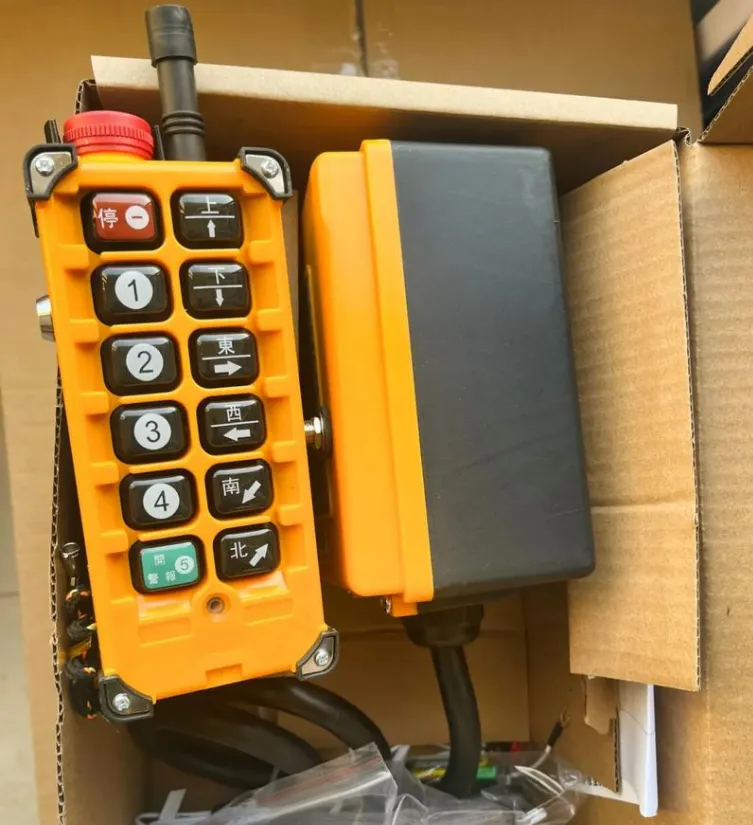
Mechanically, this works through a dual-winding motor or a motor paired with a frequency inverter that switches between two preset frequency outputs. When the operator selects fast speed, the motor receives full line frequency (50Hz or 60Hz depending on region). When slow speed is selected, the inverter or secondary winding reduces the effective frequency, often to a fraction of full speed, commonly in the range of 25 to 33 percent of maximum velocity.
Single speed control, by comparison, only offers one velocity: on or off, full speed every time. This works adequately for basic material handling where precision doesn’t matter much, moving pallets of identical items between two fixed points, for example. But the moment a load needs careful placement, near a wall, into a tight assembly fixture, or close to another worker, single speed control forces the operator to tap the button repeatedly to approximate slower movement. This “inching” technique causes motor contactor wear and jerky load movement that increases swing risk.
Why Factories Choose Double Speed Over Single Speed as a Baseline
We ask nearly every new customer the same question during initial consultation: does your process involve final positioning near people, structures, or other equipment? If the answer is yes, and for most factory floors it is, double speed becomes the practical minimum rather than an upgrade option. The cost difference between single and double speed transmitters typically runs 15 to 25 percent higher, a modest premium against the reduced product damage, fewer near-miss incidents, and lower motor contactor replacement frequency that double speed control delivers over its service life.
How Does Double Speed Compare to Variable (Stepless) Speed Control?
Buyers often ask whether they should skip double speed entirely and invest in full variable speed control from the start. The answer depends heavily on application precision requirements and budget.
| Feature | Single Speed | Double Speed | Variable (Stepless) Speed |
|---|---|---|---|
| Speed options | 1 fixed velocity | 2 fixed velocities | Infinite range between minimum and maximum |
| Control mechanism | Simple on/off contactor | Dual winding motor or two-step inverter | Full frequency inverter with analog joystick input |
| Positioning precision | Low | Moderate to good | Excellent |
| Load swing risk | Higher | Lower | Lowest |
| Typical cost premium over single speed | Baseline | 15-25% higher | 60-120% higher |
| Operator learning curve | Shortest | Short | Moderate |
| Best suited for | Basic repetitive lifting | General factory hoisting, assembly work | Precision placement, glass handling, sensitive loads |
| Motor/inverter complexity | Minimal | Moderate | High |
We tell customers handling standard palletized goods, steel coils, or general fabricated parts that double speed covers their needs completely, and spending extra on stepless variable control often doesn’t produce measurable benefit for that kind of work. Variable speed earns its higher cost specifically in applications like glass panel installation, precast concrete placement, or any load where sudden stops create dangerous pendulum swing that even a slow fixed speed can’t adequately dampen. If your process doesn’t involve that kind of swing-sensitive load, double speed remains the more cost-effective choice.
How Does the Electrical Architecture of a Double Speed Hoist Motor Work?
Understanding what happens inside the motor and control panel helps buyers and engineers troubleshoot problems and specify compatible replacement parts correctly.
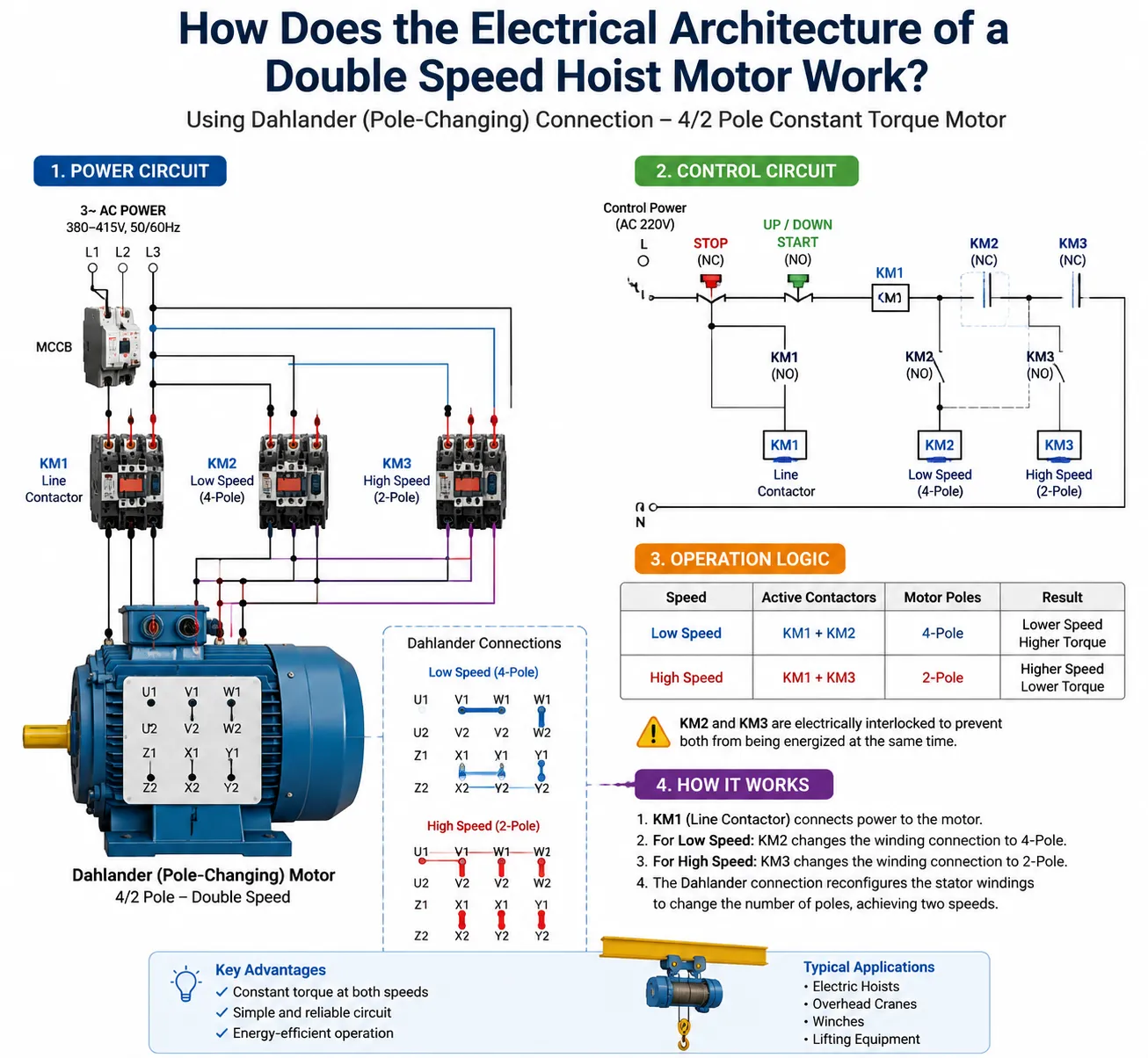
Most double speed hoist motors use one of two designs: a dual-winding (pole-changing) motor or a single-winding motor paired with a variable frequency drive (VFD) programmed with two preset speed points.
The dual-winding design contains two separate sets of windings within the same motor housing, one wound for a higher pole count (producing slow speed) and one for a lower pole count (producing fast speed). Switching between them happens through contactors that energize the appropriate winding set based on the operator’s transmitter command. This design has been standard in crane hoists for decades because of its mechanical simplicity and reliability, though it does add motor weight and cost compared to single-winding designs.
The VFD-based design uses a standard single-winding motor controlled by a frequency inverter programmed with two speed presets. The transmitter’s slow and fast commands trigger the inverter to output the corresponding frequency. This approach has become more common in newer installations because VFDs also provide additional benefits like soft-start ramping, overcurrent protection, and diagnostic feedback that pure dual-winding systems lack.
| Design Type | Speed Ratio (typical) | Advantages | Disadvantages |
|---|---|---|---|
| Dual-winding (pole-changing) motor | 4:1 (e.g., 8-pole/2-pole) | Simple, proven reliability, no separate inverter needed | Heavier motor, less flexible speed ratio, higher motor cost |
| VFD with two preset speeds | Adjustable, commonly 3:1 to 6:1 | Programmable ratio, additional diagnostic features, soft-start capability | Added component (inverter) increases points of failure, higher initial system cost |
Buyers replacing an aging system should confirm which architecture their crane currently uses before ordering a wireless remote upgrade, since the receiver’s output wiring differs between triggering a dual-winding contactor arrangement versus sending a frequency preset signal to an inverter.
What Does IP65 Rating Actually Protect on a Wireless Hoist Transmitter?
IP65 certification, established under IEC 60529, confirms an enclosure is completely sealed against dust ingress and can withstand low-pressure water jets from any angle without functional damage. For hoist transmitters used on factory floors, this rating addresses the specific hazards operators encounter daily.
| Hazard | How IP65 Addresses It |
|---|---|
| Metal dust from grinding or welding | Complete dust-tight seal prevents particle entry into PCB compartment |
| Coolant or lubricant spray from nearby machinery | Water jet resistance rating handles incidental splash and spray |
| Rain exposure for outdoor gantry crane operators | Seal design withstands directional water exposure without ingress |
| Accidental drops into puddles or wash-down areas | Gasket-sealed battery and button compartments resist moisture entry |
| Dust accumulation in cement or grain handling facilities | Dust-tight rating prevents fine particulate buildup on internal contacts |
We’ve dissected returned units from customers who purchased cheaper, non-certified “water-resistant” transmitters, and the failure pattern is consistent: water finds its way in through the battery compartment door first, then through the seam around the button membrane. A genuine IP65 unit uses a continuous silicone gasket compressed around the entire case perimeter plus a bonded, one-piece membrane keypad rather than individual rubber caps over each button. If a supplier’s transmitter uses separate button caps rather than a unified membrane, that’s often a sign the IP rating claim hasn’t gone through actual independent testing.
Why Double Speed Systems Specifically Benefit From IP65 Sealing
Double speed transmitters have more internal complexity than single-speed units, since the pressure-sensitive buttons (light press versus firm press) require additional micro-switch layers inside the button assembly to detect the two-stage actuation. This added mechanical complexity creates more potential entry points for dust and moisture if the sealing isn’t done correctly, making IP65 certification arguably more important for double speed transmitters than for simpler single-function units.
What Frequency and Signal Encoding Should a Double Speed Hoist Remote Use?
Radio frequency selection and signal encoding affect reliability, especially in facilities running multiple cranes or operating near other wireless equipment.
| Frequency Band | Typical Range | Best Suited For |
|---|---|---|
| 315 MHz | 100-200m | Basic single-crane indoor applications |
| 433 MHz | 150-300m | Standard factory hoist and crane control, good obstacle penetration |
| 868 MHz | 200-350m | European facilities, lower interference in licensed band |
| 2.4 GHz | 100-250m (shorter through obstacles) | Applications needing higher data rates or bidirectional feedback |
For double speed hoist control specifically, 433 MHz remains the most common choice in industrial settings because the two-stage button signal (distinguishing light press from firm press) needs reliable, low-latency transmission, and 433 MHz’s penetration through steel structures makes it dependable in the metal-heavy environment typical of factory floors and warehouses.
Rolling code encoding matters just as much for double speed systems as for any other crane transmitter type. Since a facility running multiple hoists side by side risks cross-triggering if two transmitters use fixed, identical codes, rolling code technology, where each transmission carries a synchronized, changing code recognized only by its paired receiver, prevents one operator’s transmitter from accidentally activating a neighboring crane’s slow or fast speed function.
How Do You Wire and Commission a Double Speed Wireless Remote to an Existing Crane?
Installation on an existing crane involves connecting the wireless receiver’s output contacts to the crane’s motor control panel, matching each transmitter button function to the correct contactor or inverter input.
The general commissioning sequence looks like this: mount the receiver inside or adjacent to the crane’s existing control panel, protected from direct exposure to weather and vibration. Wire the receiver’s slow-speed and fast-speed output contacts to the corresponding contactors (for dual-winding motors) or to the appropriate digital input terminals on the VFD (for inverter-based systems). Power up the system and pair the transmitter to the receiver following the manufacturer’s learn-code procedure, typically holding a button combination on both units within a set time window.
Commissioning Checklist for Double Speed Systems
| Step | Purpose |
|---|---|
| Confirm motor architecture (dual-winding vs VFD) before wiring | Prevents miscommunication between transmitter output and crane hardware |
| Verify slow speed actually produces reduced velocity, not just reduced torque | Confirms winding or inverter preset wired correctly |
| Test light-press vs firm-press button differentiation | Ensures pressure-sensitive switch mechanism functions as designed |
| Confirm direction commands match physical crane movement | Prevents operator confusion and potential safety incident |
| Test emergency stop cuts both speed settings immediately | Verifies fail-safe circuit independent of speed selection |
| Range test at maximum working distance within the facility | Confirms signal reliability across the full operational area |
| Document final wiring diagram and pairing codes | Provides reference for future service or transmitter replacement |
We’ve handled service calls where a facility’s maintenance team wired the slow and fast contacts backward, meaning firm button press produced slow movement and light press produced fast movement, the opposite of what operators expected. This kind of reversed wiring doesn’t damage equipment, but it creates genuine safety confusion, particularly for operators trained on other cranes with standard button behavior. Testing actual physical response against expected response before releasing a crane back into service catches this immediately.
What Safety Considerations Are Unique to Double Speed Hoist Operation?
Double speed introduces a specific safety consideration that single-speed systems don’t have: operators must correctly judge which speed setting suits the current phase of the lift, and a mistake in that judgment carries real consequences.
| Risk Scenario | Why Double Speed Requires Attention | Mitigation |
|---|---|---|
| Operator uses fast speed during final load placement | Overshoots target position, risk of collision or crushing | Training reinforcement, physical button differentiation (larger slow-speed button) |
| Speed change happens mid-lift without operator intent | Sudden acceleration or deceleration causes load swing | Ramp transition circuits that smooth the shift between speeds |
| New operators default to fast speed out of habit from single-speed cranes | Reduced precision, higher incident risk during transition period | Structured onboarding specifically covering two-speed operation |
| Slow speed used near end-of-travel limits without deceleration awareness | Repeated limit switch strikes, mechanical wear | Limit switch pre-slowdown zones programmed into control logic |
Facilities transitioning operators from single-speed to double-speed cranes should budget for a genuine training period rather than assuming the transition is intuitive. We recommend at minimum a half-day supervised practice session where new double-speed operators handle test loads under observation before working with production loads. Most of the safety benefit double speed control offers depends entirely on operators actually using the slow setting appropriately, and that habit needs deliberate reinforcement rather than assumption.
What Should You Check Before Buying a Double Speed Wireless Hoist Remote?
Buyers comparing suppliers should evaluate several factors beyond the basic double speed and IP65 specifications advertised on most product pages.
| Evaluation Criterion | What to Ask the Supplier |
|---|---|
| Speed ratio specification | What is the actual slow-to-fast speed ratio, and is it adjustable? |
| Button differentiation mechanism | Does the transmitter use pressure-sensitive buttons or separate slow/fast buttons? |
| Compatibility with existing motor type | Does the receiver output match dual-winding contactor logic or VFD digital input requirements? |
| IP rating verification | Can the supplier provide actual IEC 60529 test documentation, not just a printed rating? |
| Rolling code capability | Does the system use rolling code encoding to prevent cross-triggering with nearby cranes? |
| Emergency stop circuit design | Is the E-stop hardwired and fail-safe independent of the RF signal? |
| Battery type and expected life | Rechargeable lithium versus replaceable alkaline, and realistic runtime under daily use |
| Warranty and spare parts availability | How long will replacement transmitters and receivers remain available for this model? |
We always encourage buyers to request a sample unit for bench testing before committing to a full facility order, particularly for the speed ratio question. Some budget transmitters advertise “double speed” but deliver a barely noticeable difference between settings, closer to a 1.5:1 ratio rather than the 3:1 to 4:1 ratio that provides genuinely useful positioning control. A quick side-by-side test against a known-good unit reveals this immediately.
How Much Does a Double Speed Wireless Crane Remote System Cost?
Pricing depends on channel count, motor compatibility (dual-winding versus VFD), IP rating, and certification level. As a general 2026 market reference:
| Configuration | Approximate Price Range (USD, per set) |
|---|---|
| 4-channel double speed, IP54, basic fixed code | $90 to $150 |
| 6-channel double speed, IP65, rolling code | $160 to $280 |
| 8-channel double speed, IP65, VFD-compatible with diagnostic feedback | $260 to $450 |
| 10+ channel double speed, IP66, multi-crane pairing, ATEX-rated | $500 to $900+ |
Bulk orders for facilities equipping multiple cranes typically see 15 to 30 percent per-unit savings, though buyers should confirm that receiver units are included in quoted pricing, since some suppliers price transmitters and receivers separately. We recommend requesting total installed system cost, including any inverter reprogramming labor if converting from single to double speed, before comparing quotes across different manufacturers, since the transmitter price alone doesn’t reflect the full project cost when motor or inverter modifications are also required.
How Do You Maintain a Double Speed Hoist Remote for Long Service Life?
Double speed transmitters have more internal mechanical complexity than single-speed units due to the pressure-sensitive button mechanisms, which makes routine maintenance slightly more involved but no less important.
| Maintenance Task | Frequency | Purpose |
|---|---|---|
| Test light-press and firm-press differentiation on all direction buttons | Weekly | Catches early micro-switch wear before complete failure |
| Battery voltage check | Monthly | Prevents unexpected shutdown during operation |
| Visual inspection of casing seams and battery door gasket | Weekly | Identifies seal wear before water ingress occurs |
| Emergency stop function test | Weekly | Confirms fail-safe circuit remains functional |
| Antenna inspection | Quarterly | Detects damage reducing range or reception reliability |
| Speed ratio verification against baseline | Quarterly | Confirms slow speed hasn’t drifted toward fast speed due to inverter or contactor wear |
| Full pairing re-verification after any battery replacement | As needed | Ensures rolling code synchronization remains intact |
The speed ratio verification task is specific to double speed systems and often gets skipped in generic maintenance checklists borrowed from single-speed transmitter programs. Contactor wear in dual-winding systems or parameter drift in VFD presets can gradually narrow the gap between slow and fast speed without any obvious external symptom, until an operator notices the “slow” setting no longer feels meaningfully different from fast. Quarterly verification against documented baseline speeds catches this drift before it erodes the precision benefit the system was purchased to provide.
Why Choose Nomi for Double Speed Wireless Hoist Control Systems?
We’ve built double speed crane transmitters specifically around the button differentiation problem that causes the most field complaints in this product category, weak or inconsistent distinction between light and firm press. Our pressure-sensitive switch assemblies go through over 200,000 actuation cycle testing at both press levels to confirm the two-stage response stays consistent throughout the transmitter’s service life, not just when it leaves the factory.
Every IP65 unit we produce goes through swing-arm spray chamber testing under IEC 60529 protocols, and we test compatibility with both dual-winding motor contactor logic and standard VFD digital input configurations before releasing any new transmitter model, because we’ve seen too many customers get stuck with a unit that doesn’t match their actual crane hardware. Our engineering team will review your existing motor and control panel setup before recommending a specific configuration, and we maintain spare parts and replacement transmitters for our product lines going back several years, since we know a crane going down for lack of a compatible replacement remote costs a facility real production time.
If you’re comparing double speed systems from multiple suppliers, ask specifically about the actual speed ratio delivered, the button switch cycle testing data, and whether the receiver has been tested against your specific motor architecture. These three questions reveal more about long-term reliability than any general spec sheet comparison.
Frequently Asked Questions
What is the typical speed ratio in a double speed hoist control system?
Most industrial double speed hoist systems use a ratio between 3:1 and 4:1, meaning fast speed runs three to four times faster than slow speed. This ratio provides enough distinction for operators to clearly feel the difference during final positioning while keeping general travel efficient, and buyers should verify actual ratio specifications before purchase since some budget units offer a much less useful 1.5:1 difference.
Can I retrofit a single speed crane with a double speed wireless remote?
Retrofitting requires the motor and control panel to support two-speed operation, either through a dual-winding motor or a VFD with programmable speed presets. If the existing motor only has single-winding construction with no inverter, the motor itself needs replacement or a VFD must be added before a double speed transmitter can deliver any actual speed variation benefit.
How does IP65 rating differ from IP54 on a hoist remote control?
IP65 provides complete dust-tight protection plus resistance to low-pressure water jets from any direction, while IP54 only offers limited dust protection and resistance to splashing water. For factory environments with metal dust, coolant spray, or wash-down cleaning, IP65 represents the more reliable choice, while IP54 suits drier indoor environments with minimal moisture exposure.
Why does my double speed crane remote’s slow setting feel the same as fast speed?
This usually indicates contactor wear in a dual-winding motor system or parameter drift in a VFD’s speed presets, both of which gradually narrow the actual velocity difference between settings over time. Quarterly speed ratio verification against documented baseline measurements catches this drift early, and recalibrating the VFD preset or replacing worn contactors typically restores proper differentiation.
What causes cross-triggering between multiple cranes using wireless remotes?
Cross-triggering happens when transmitters use fixed, non-rolling codes that another nearby transmitter can accidentally duplicate or interfere with, causing one operator’s commands to activate a different crane. Rolling code technology, which changes the transmitted code pattern with every button press, prevents this by requiring synchronized code matching between each specific transmitter and receiver pair.
Is a VFD-based double speed system better than a dual-winding motor system?
VFD-based systems offer more flexibility through adjustable speed ratios and additional diagnostic features like soft-start ramping and overcurrent protection, while dual-winding motors provide simpler, time-tested mechanical reliability without inverter-related failure points. The better choice depends on whether the facility values programmability and diagnostics or values mechanical simplicity with fewer electronic components to maintain.
How do I know if my current transmitter’s IP65 rating is genuine?
Request actual IEC 60529 test documentation from the supplier rather than accepting a printed rating on the packaging, and inspect whether the transmitter uses a continuous silicone gasket around the case seam and a bonded one-piece membrane keypad rather than individual rubber button caps. Units using separate caps over each button frequently haven’t undergone genuine independent IP65 testing despite marketing claims.
What training do operators need when switching from single speed to double speed cranes?
Operators transitioning from single-speed to double-speed cranes should complete at minimum a half-day supervised practice session handling test loads before working with production loads, since the habit of defaulting to full speed from single-speed experience can reduce the safety benefit double speed control is meant to provide. Structured onboarding that specifically addresses when to use slow versus fast speed produces measurably better safety outcomes than assuming the transition is intuitive.
Can a double speed hoist remote work with multiple cranes from one transmitter?
Yes, some double speed transmitter models support multi-crane pairing through a selector function, allowing one operator to switch control between two or more paired receivers on different cranes. This requires each receiver to have a unique address code and the transmitter to display which crane is currently active, typically through an LED indicator or small screen.
What is the expected service life of a double speed wireless hoist remote?
A well-maintained double speed transmitter with IP65 sealing typically lasts 4 to 6 years under normal industrial use, though the pressure-sensitive button mechanisms may show wear slightly earlier than simple single-speed buttons due to their added mechanical complexity. Regular button differentiation testing and prompt battery compartment seal inspection extend service life closer to the upper end of that range.
Take the Next Step
If your facility is still running single-speed hoists where precision placement has become a bottleneck, or if your existing double speed system no longer delivers a meaningful difference between slow and fast settings, our team at Nomi can assess your current motor architecture and recommend a wireless remote configuration built for your actual equipment. Reach out for a technical consultation, request a sample transmitter for bench testing before a full facility order, and let our field experience with dual-winding and VFD-based hoist systems help you specify a solution that holds up to years of daily factory use.
Sources
- International Electrotechnical Commission, IEC 60529: Degrees of Protection Provided by Enclosures (IP Code).
- Occupational Safety and Health Administration, OSHA 1910.179: Overhead and Gantry Cranes Standard.
- National Electrical Manufacturers Association, NEMA Motor and Generator Standards (MG 1).
- Federal Communications Commission, FCC Part 15 Radio Frequency Devices Regulations.
- European Commission, Radio Equipment Directive (RED) 2014/53/EU.
- International Organization for Standardization, ISO 13849-1: Safety of Machinery, Safety-Related Parts of Control Systems.